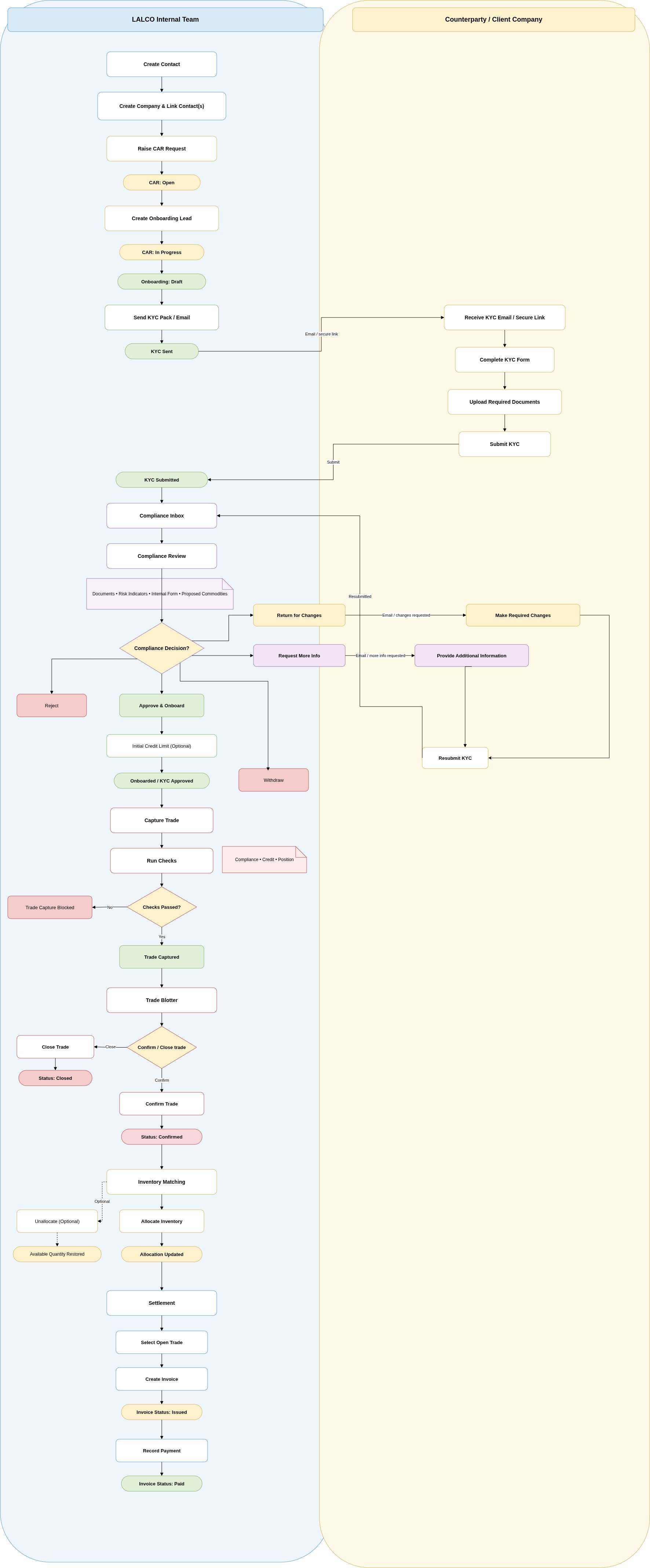
Commodity Trading and Risk Management
CTRM a centralized platform for managing commodity trading activities. Bringing together client management, trading, risk management, operations contracts, logistics, documents and administration in one environment. Users are able to manage client information, capture and monitor trades, support compliance, manage inventory and settlement and access valuation, P&L, risk hedging and market data functions.
Workspace
The Workspace provides users with a high-level view of information available within the CTRM system. It includes dashboards and reporting functions that allow users to monitor key information and review business and sales-related data.
1. Dashboard
1.1 Dashboard
The Dashboard provides a firm-wide overview of key information across the CTRM system. It allows users to quickly monitor the current trading, financial, and risk position without opening each individual module.
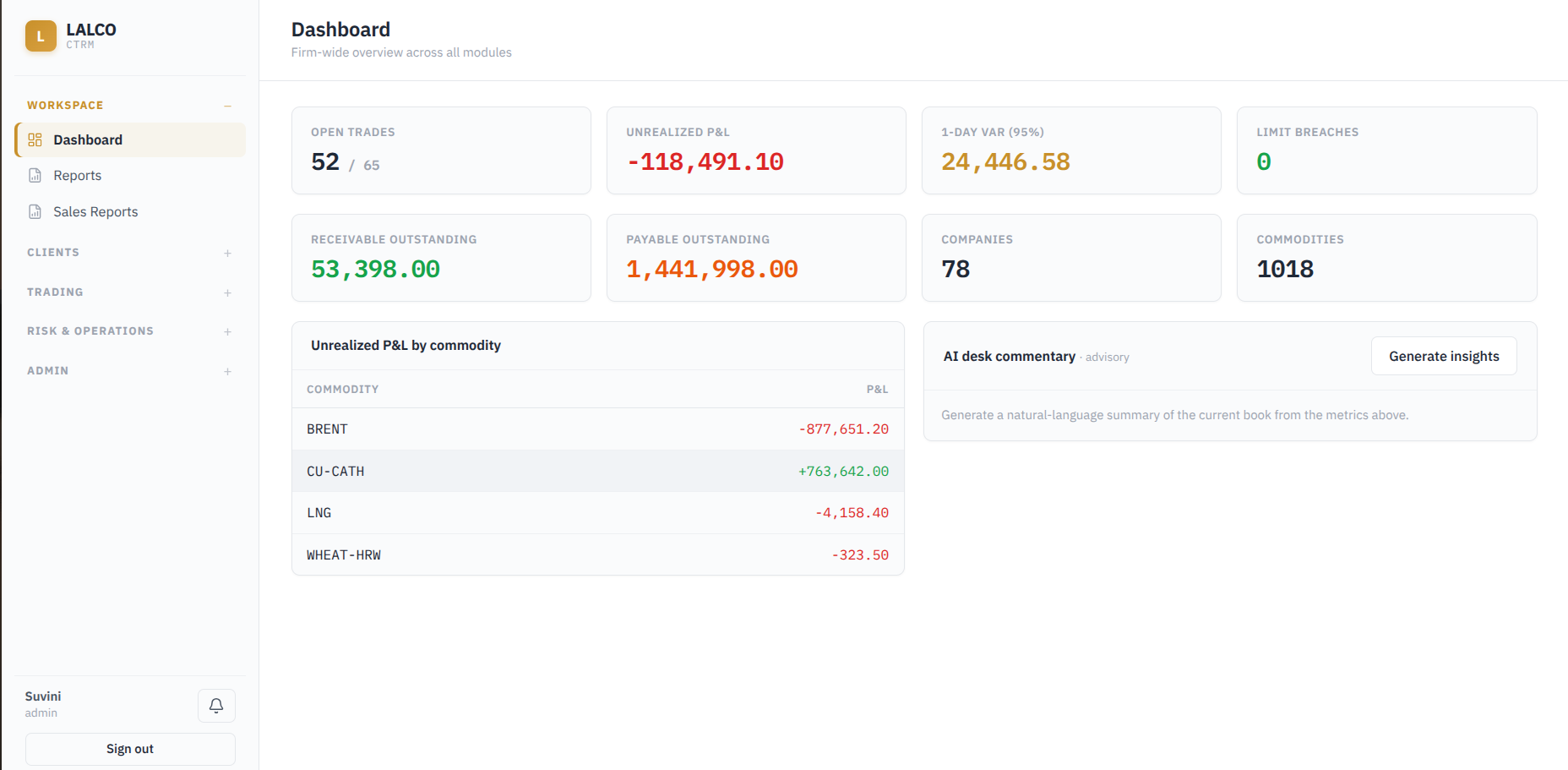
Key indicators :
- Open Trades
- Unrealized P&L
- 1-Day VaR (95%) (Max expected Loss
- Limit Breaches
- Receivable Outstanding
- Counterparties
- Commodities
- Unrealized P&L by commodity
Key Characteristics :
- AI Desk Commentary : Generates a natural language summary of the current book based on the metrics displayed on the dashboard.
1.2 Reports
The Reports module allows users to generate and download key management, trading, risk, settlement, and inventory reports. The reports can be downloaded in Pdf
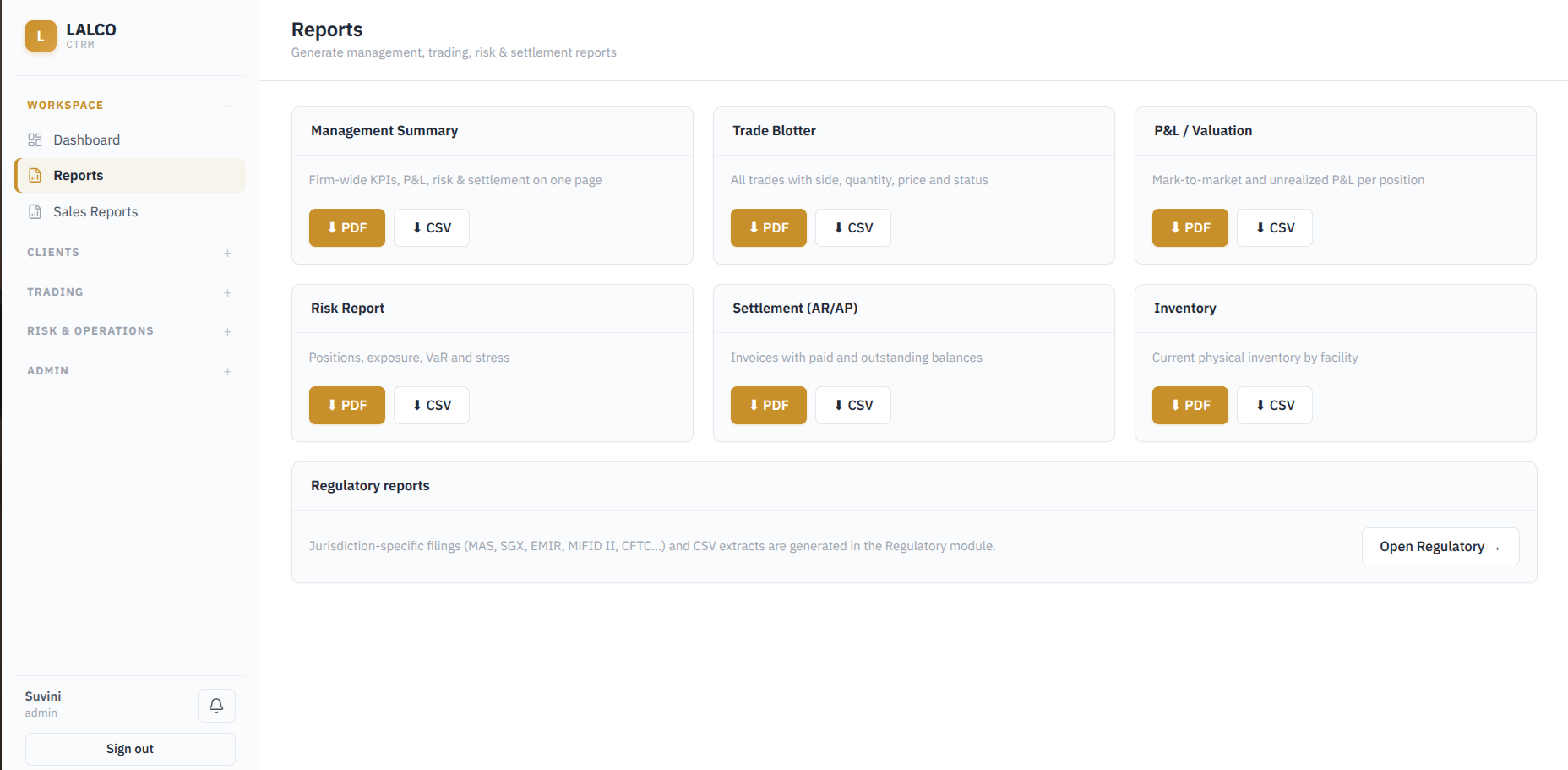
Available Reports:
- Management Summary: Firm wide KPIs, P&L, Risk and settlement information
- Trade Blotter: Overall view of recorded trades, including the trade side (Buy/Sell), quantity price, and current status.
- P&L / Valuation: Mark-to-market values and unrealized P&L by position.
- Risk Report: Positions, exposure, VaR, and stress information
- Settlement(AR/AP): Invoices, paid amounts, and outstanding balances.
- Inventory: Current physical inventory by facility.
Key Characteristic:
- Regulatory reports are handled separately through the Regulatory module, which can be accessed directly from the Reports page.
1.3 Sales Reports
The Sales Reports module provides sales-related reporting based on a selected time period.
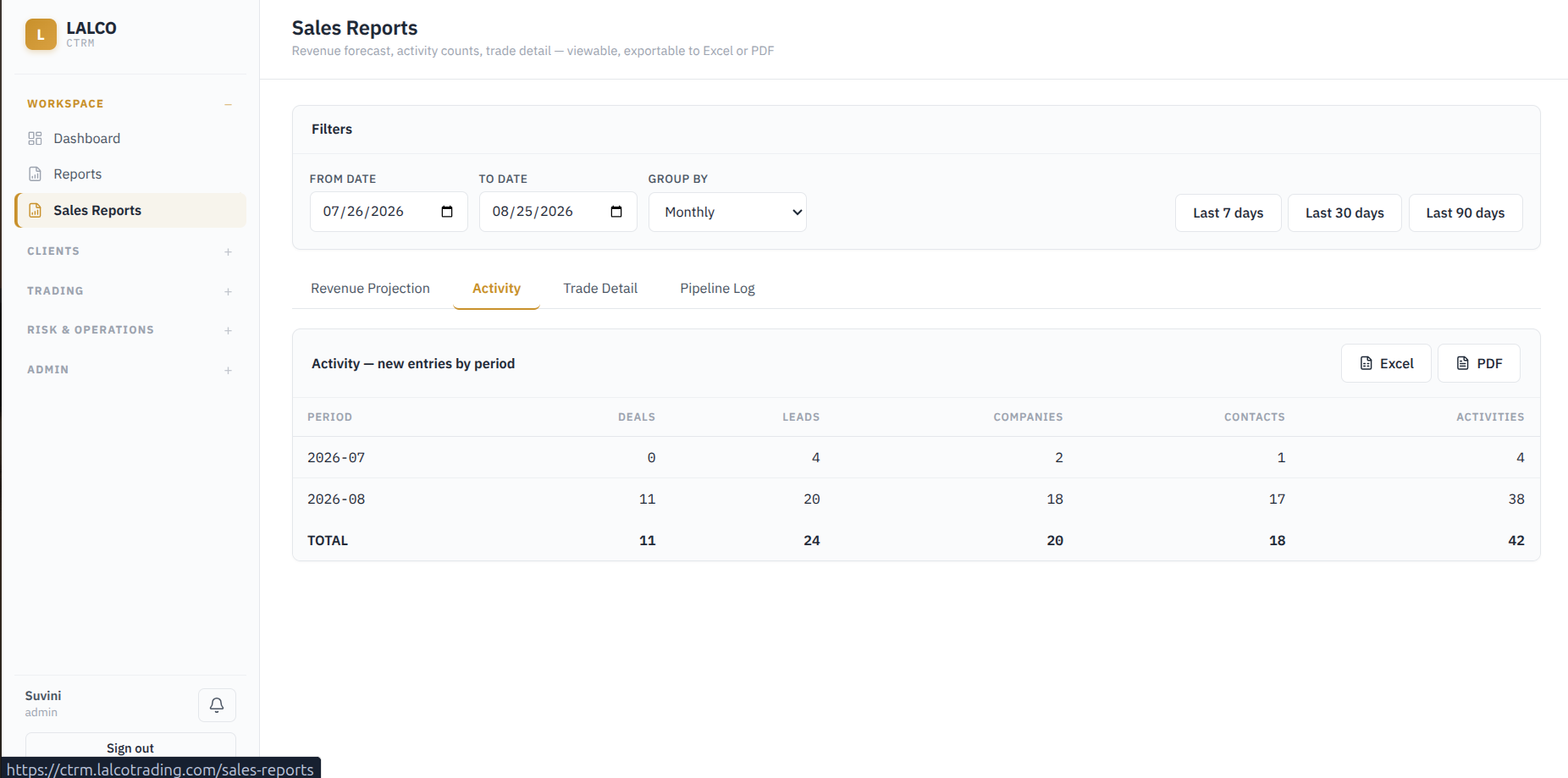
Report Views :
- Revenue projection
Displays projected revenue by trader and period, including the weighted value, raw value, and number of deals.

- Activity
Displays the number of records related to Deals, Leads, Companies, Contacts, Activities
- Trade Detail
Individual trades recorded and main information related to each trade. Including Ref, Date, B/S, Commodity, Company, Qty, Price, Notional, Status, Trader, Latest Note, Next Step

- Pipeline Log
Chronological record of activities and changes made within the sales pipeline. Helps to see What happend (Event), When it happend (When) and who performed the action (Actor) and the description.

Reports can be filtered by :
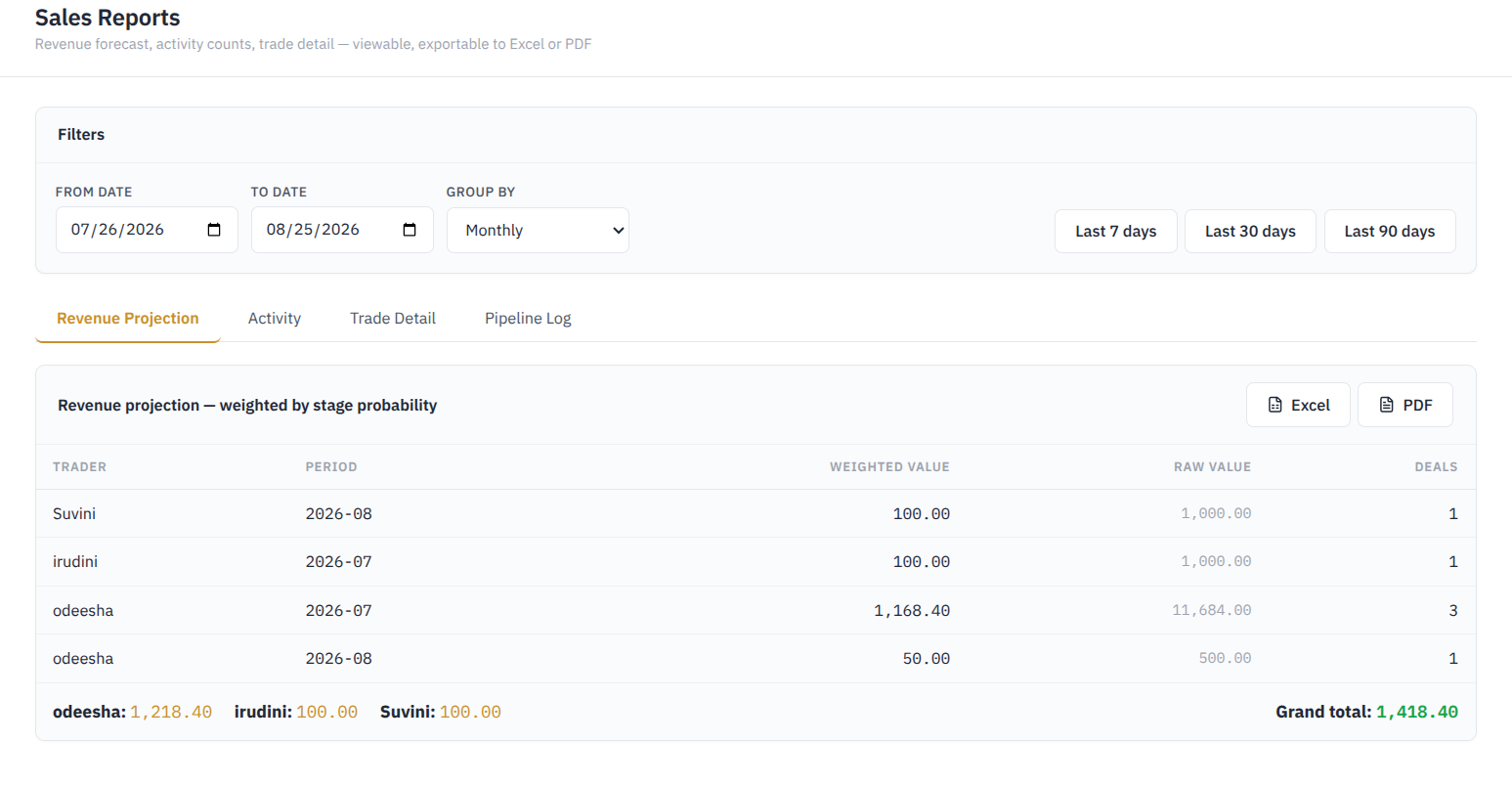
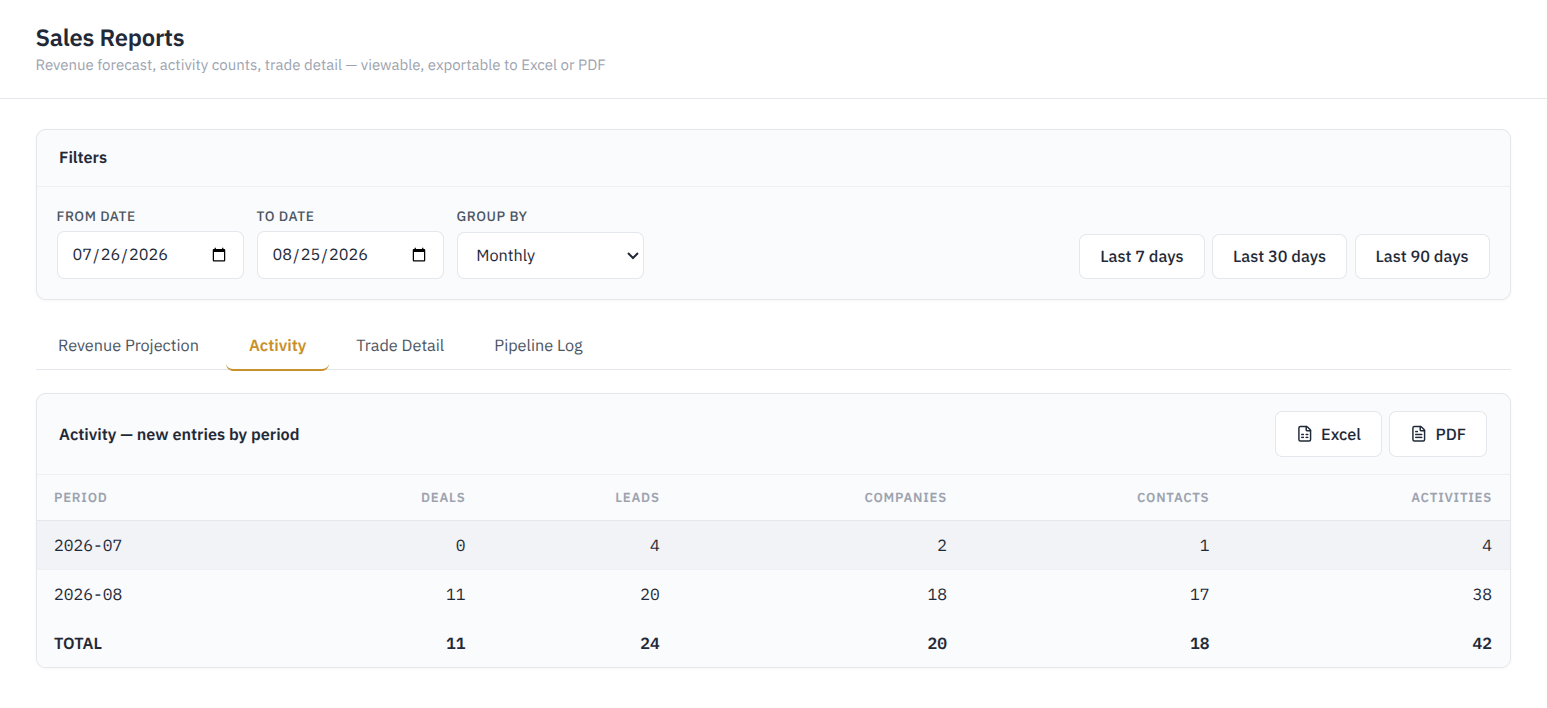
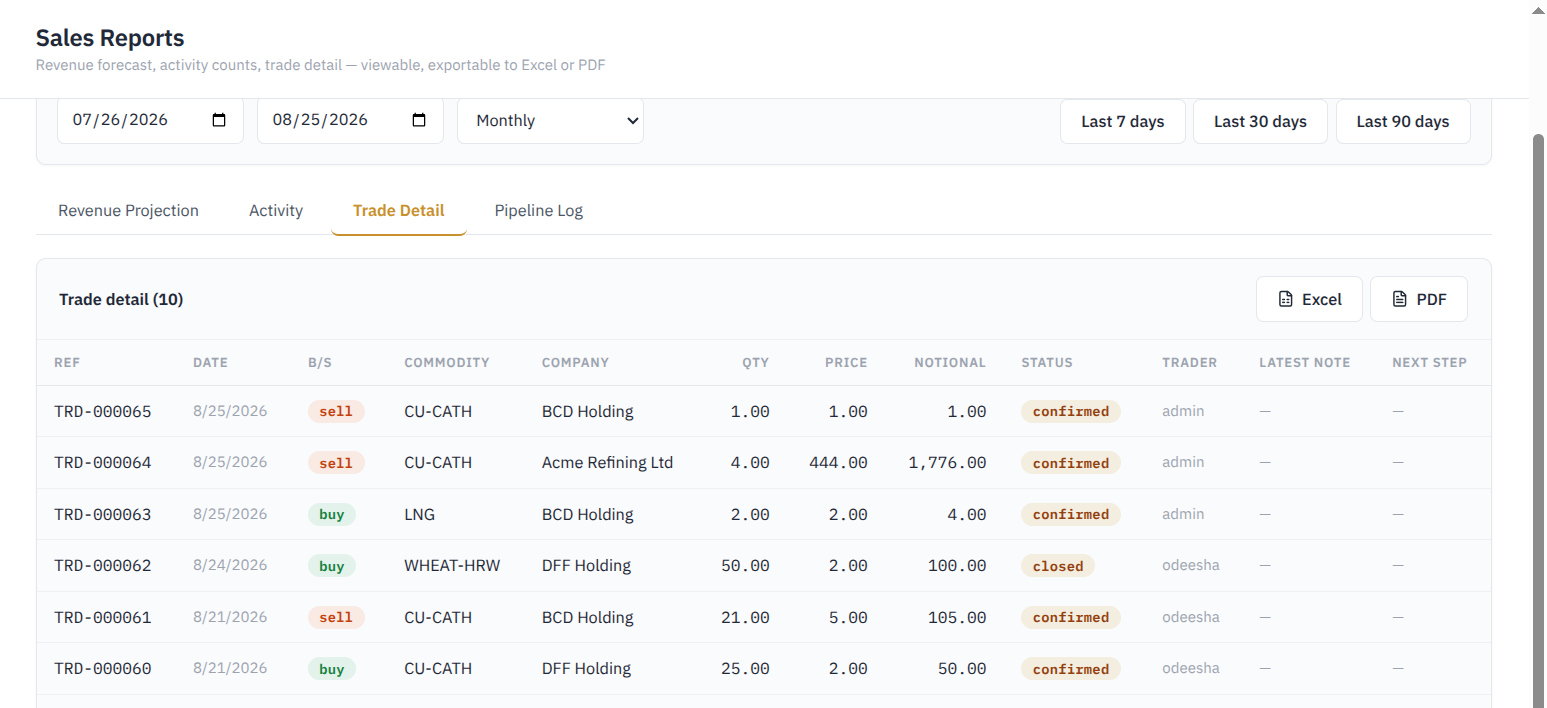
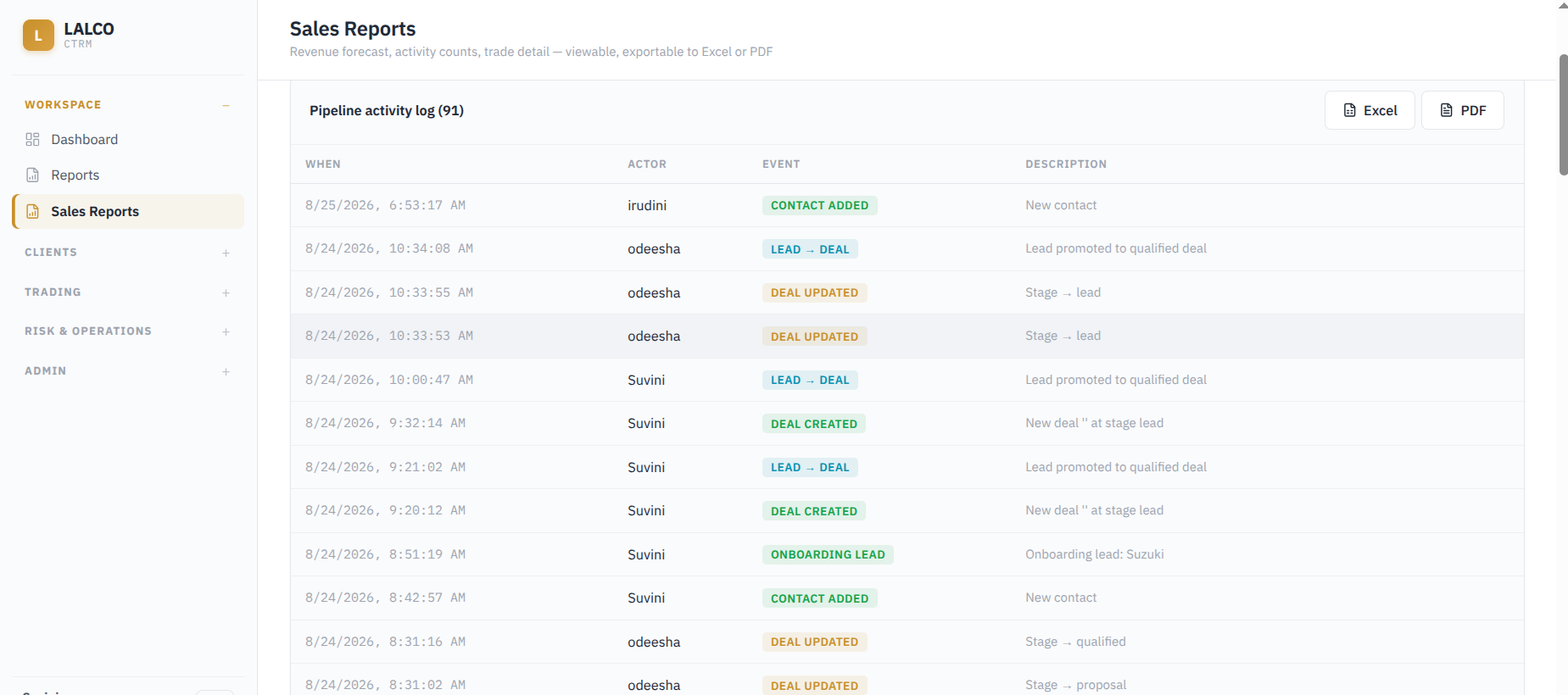
- From Date
- To Date
- Group by (Monthly, Weekly, Daily)
- Last 7 Days
- Last 30 Days
- Last 90 Days
2.Client
Overview
The Clients section is used to manage client and counterparty-related information within the CTRM system. It supports the handling of contacts, companies, onboarding, compliance, leads, pipeline activities, and overall client relationship management.
2.1 Contacts
Used to store and manage individual people associated with counterparty organizations. Maintains key information : Name, Email, Phone number
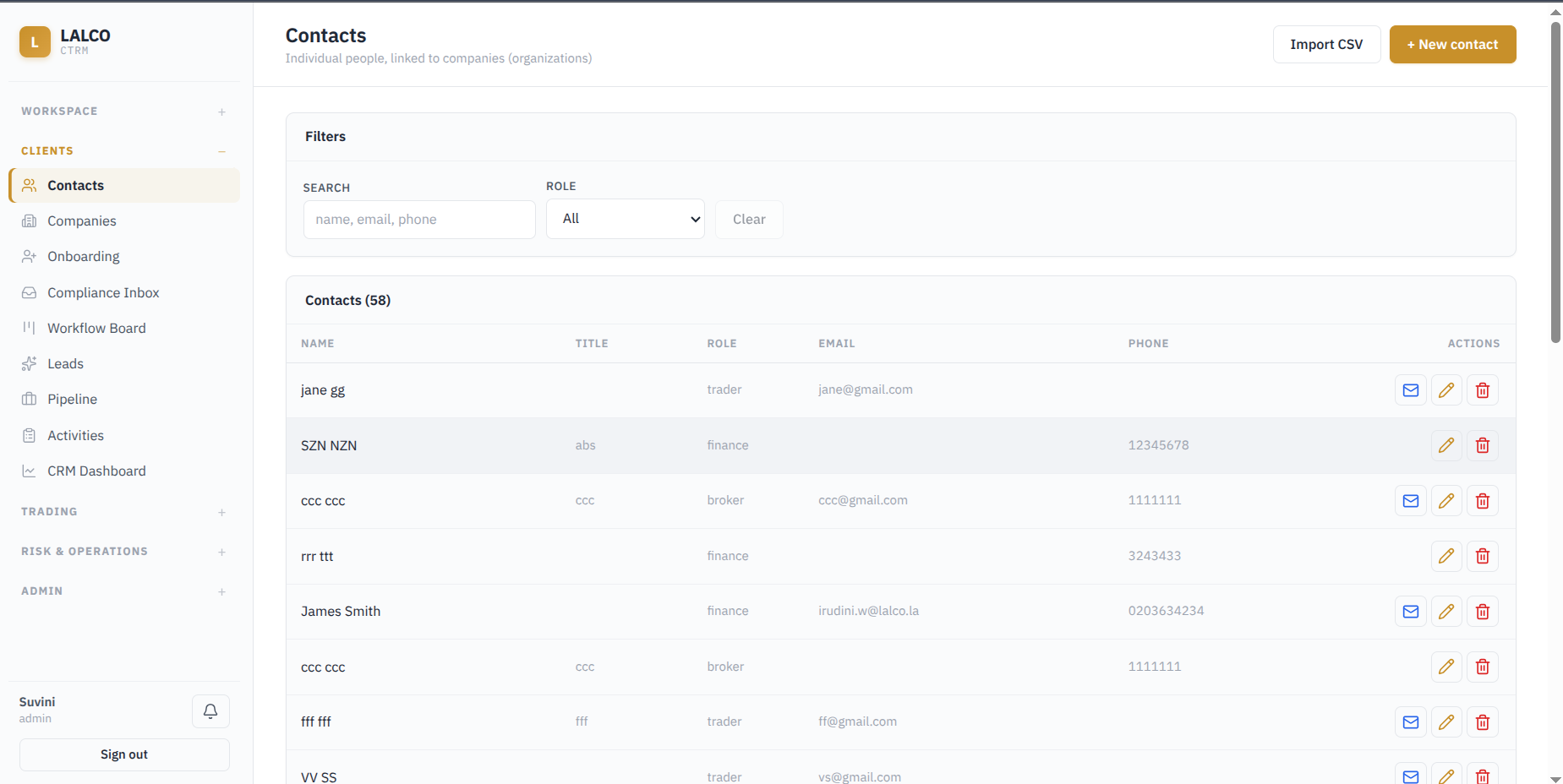
Filters
- Search: Find contacts using name, email, or phone number
- Role: Filters contacts according to their assigned roles
Main Functions
- Add a new contact
- Import contacts using a CSV file
- Edit or delete existing contacts
- Send an email directly when a email address is available
Methods to add a contact
1. Import Contacts from CSV
Allows multiple contacts to be added at once by uploading a CSV file up to 5 MB.
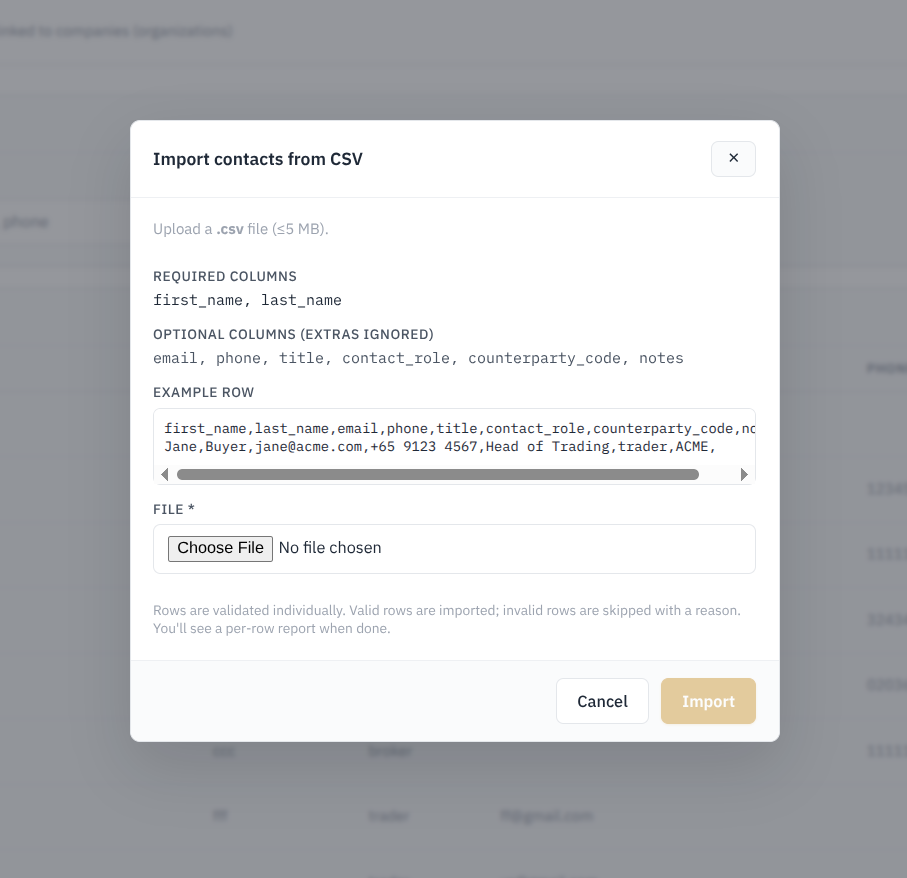
- Required Columns: first_name , last_name
- Optional columns: email, phone, title, contact_role, counterparty_code, notes
- Additional columns that are not required are ignored by the system
- Each row is validated indivually before being imported
- Valid rows are imported, while invalid rows are skipped with the reason provided
- A row-by-row import report is displayed after the process is completed.
Key Characterisitc
Counterparty Code – Identifies the counterparty organization that the contact belongs to. When contacts are imported through a CSV file, this code helps the system link each contact to the correct counterparty automatically.
2. Manual Entry of a company
Allows users to manually create an individual contact record within the system.
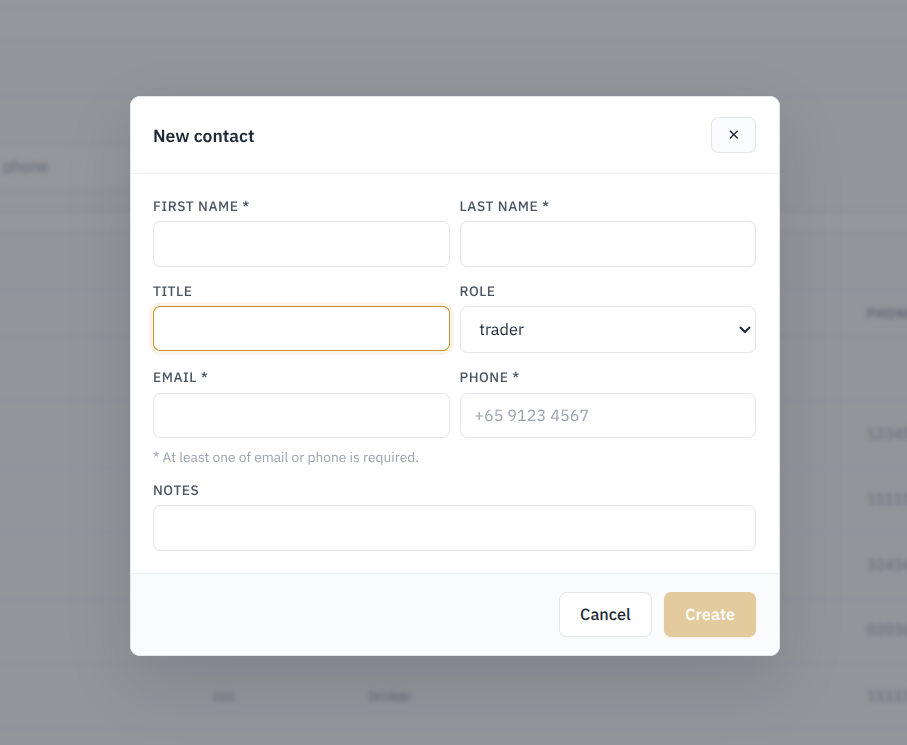
Fields:
- First name
- Last Name
- Title (Job title/position)
- Role (Business role)
- Phone
- Notes
Validations :
- First name and Last name are mandatory
- At least one contact method, either Email or Phone must be provided.
2.2 Companies
Used to manage the organizations that the business trades or works with. Each company is maintained as a counterparty record with its identifying details, type, country, limit, and current status.
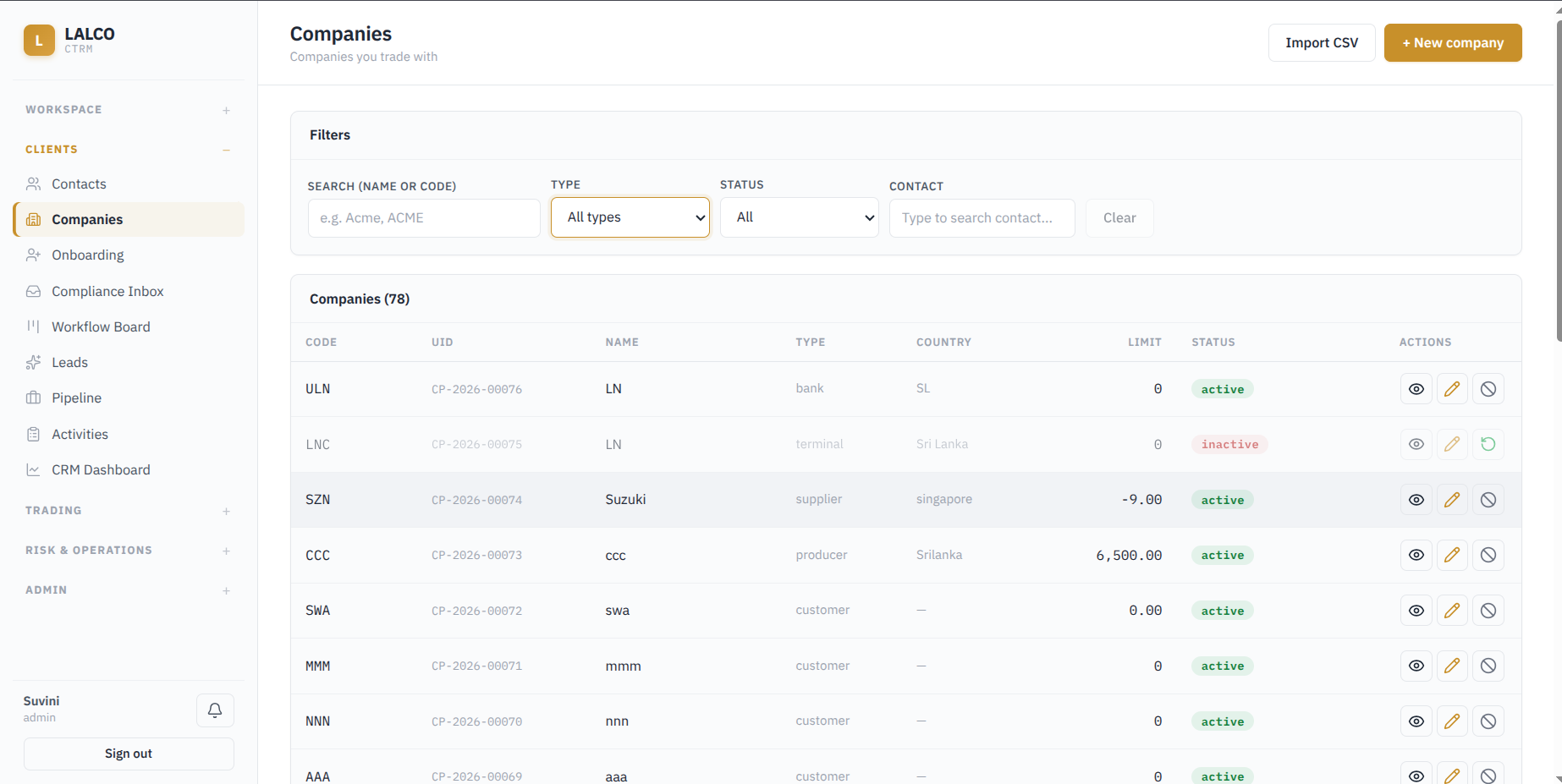
Filters
- Search by name or code - Find a company by company by it's name or company code.
- Type - Filter according to the company type (customer, supplier, producer etc)
- Status - Inactive or active
- Contact - Finds companies associated with a particular contact
Main Functions
- Add a new company.
- Import company records through CSV.
- View company details.
- Edit an existing company.
- Deactivate an active company or reactivate an inactive company.
Methods to add a companies
1. Import companies from csv
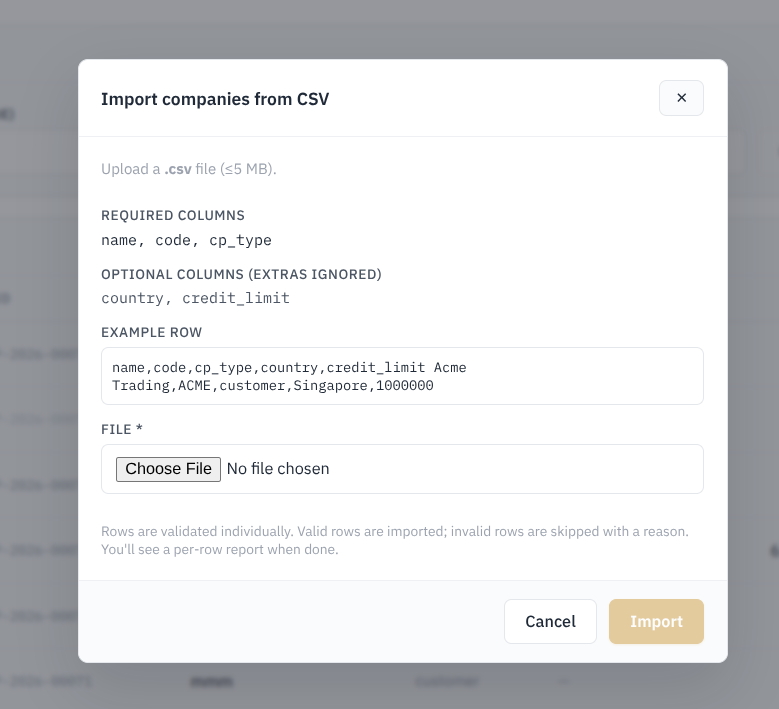
Required columns : Name , Code , CP Type (Counterparty type)
Optional columns: Country, Credit Limit
Validations
Each row in the CSV file is checked separately before import.
- Valid rows are imported successfully.
- Invalid rows are skipped.
- The system provides a reason for any rejected row.
- A row-by-row import report is shown after the import is completed.
2. Manual Entry of a company
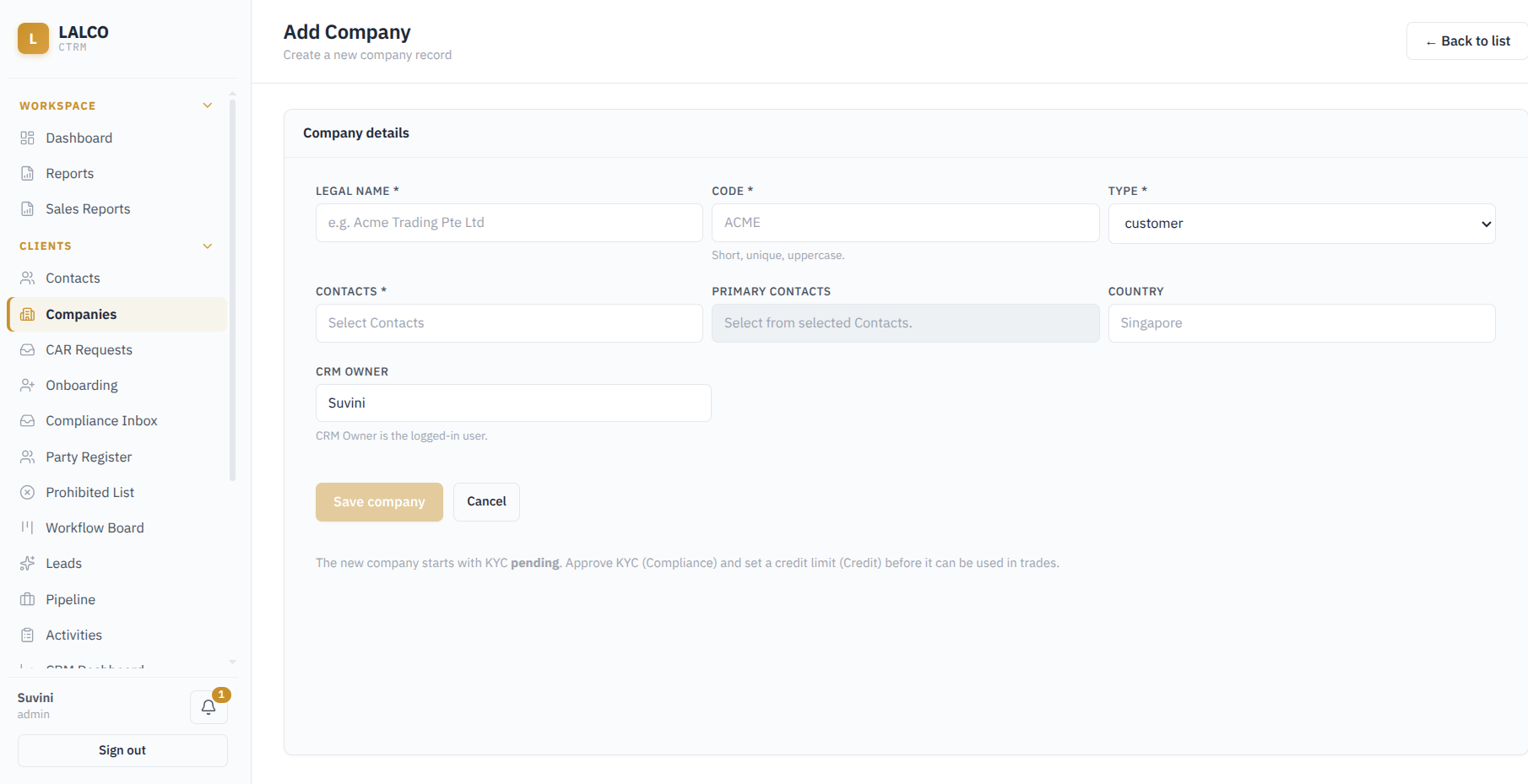
Fields to create a new company
- Legal Name – Official name of the company. Required.
- Code – Short, unique uppercase code used to identify the company. Required.
- Type – Defines the counterparty type, such as customer. Required.
- Contacts – Links existing contacts to the company. (contact assigned already cannot be assigned again) Required.
- Primary Contacts – Identifies the main contact person from the selected contacts.
- Country – Country associated with the company.
- CRM Owner - The logged in user. Read-Only
Key Requirement
A newly created company starts with KYC (Know Your Cusomter) Pending status. Before the company can be used in trades:
- KYC must be approved through the Compliance process.
- A credit limit must be assigned through the Credit process.
Displayed details
- Code – Short code assigned to the company.
- UID – Unique system identifier for the company.
- Name – Company name.
- Type – Classification of the company.
- Country – Country in which the company is associated or registered.
- Limit – Limit value configured for the company.
- Status – Indicates whether the company is currently active or inactive.
View Company
The View Company page provides a complete profile of the selected company and brings together its related information in one place.
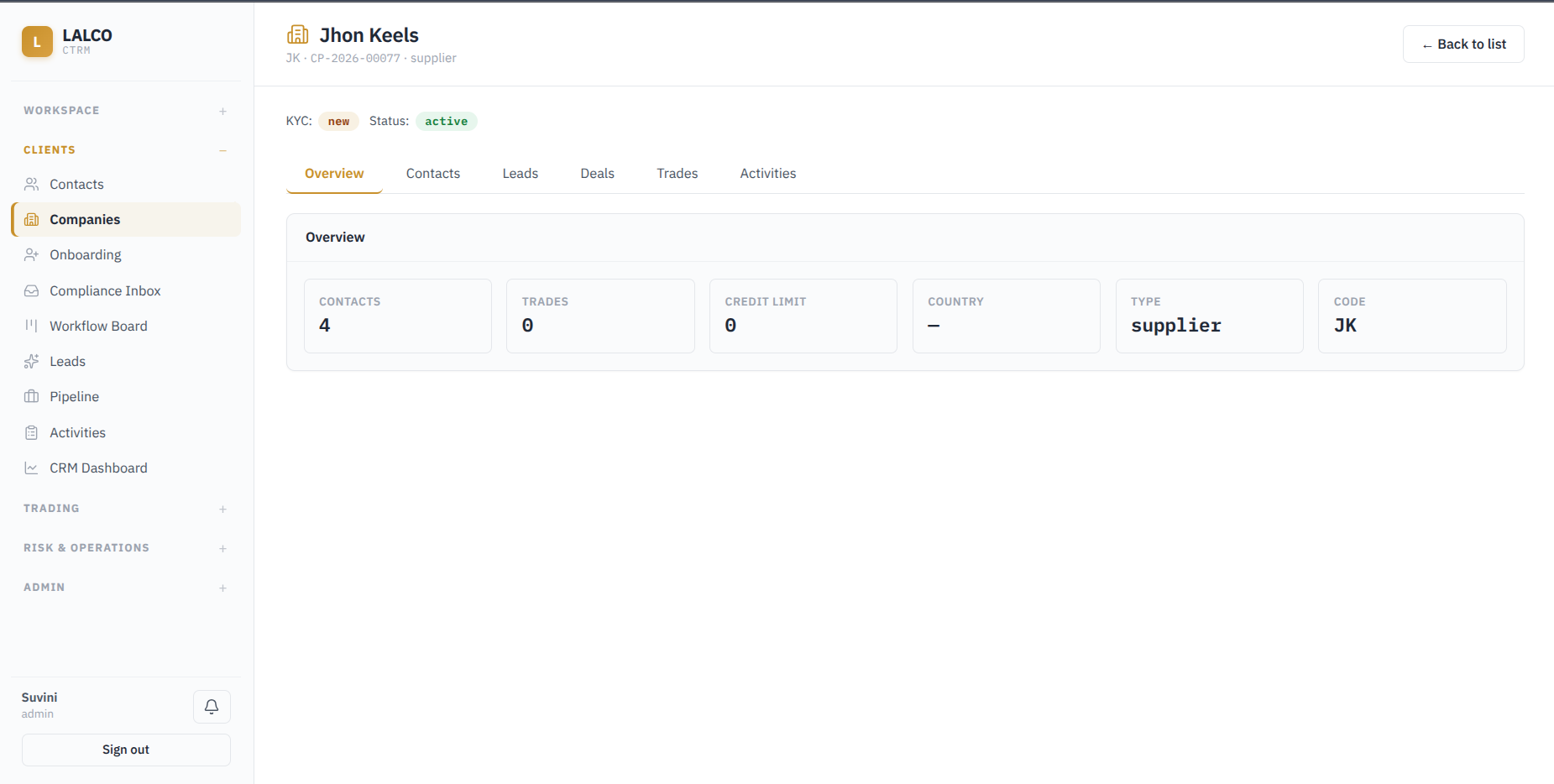
Provides a summary of :
- Contacts – Number of contacts linked to the company.
- Trades – Number of trades associated with the company.
- Credit Limit – Current credit limit assigned to the company.
- Country – Country associated with the company.
- Type – Counterparty type, such as supplier or customer.
- Code – Short code used to identify the company.
Edit Company details
- Legal Name – Updates the official company name.
- Type – Changes the counterparty type, such as supplier or customer.
- Country – Updates the country associated with the company.
- Status – Changes whether the company is active or inactive.
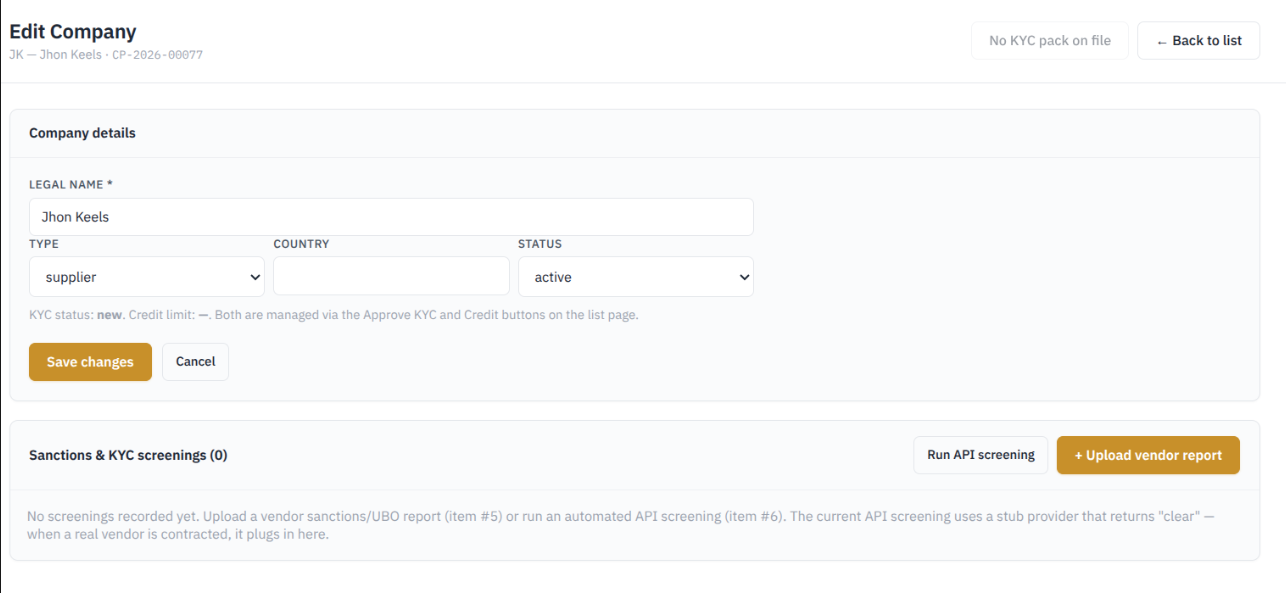
The KYC status and Credit Limit cannot be changed directly from this page. These are managed separately through the relevant KYC approval and credit functions.
Sanctions & KYC Screening
Used to record checks performed on the company as part of the KYC and compliance process.
- Run API Screening – Performs an automated screening of the company. Currently, the system uses a test/stub screening provider (To be edited)
- Upload Vendor Report – Allows a sanctions or UBO (Ultimate Beneficial Owner) screening report obtained from an external provider to be uploaded.
- Previous screening results are recorded in this section when available
2.3 CAR Request
Used to raise and manage Compliance Application Required (CAR) requests initiated by Trade Finance or Logistics. It allows users to track requests submitted for companies and monitor their progress through the compliance/KYC process.
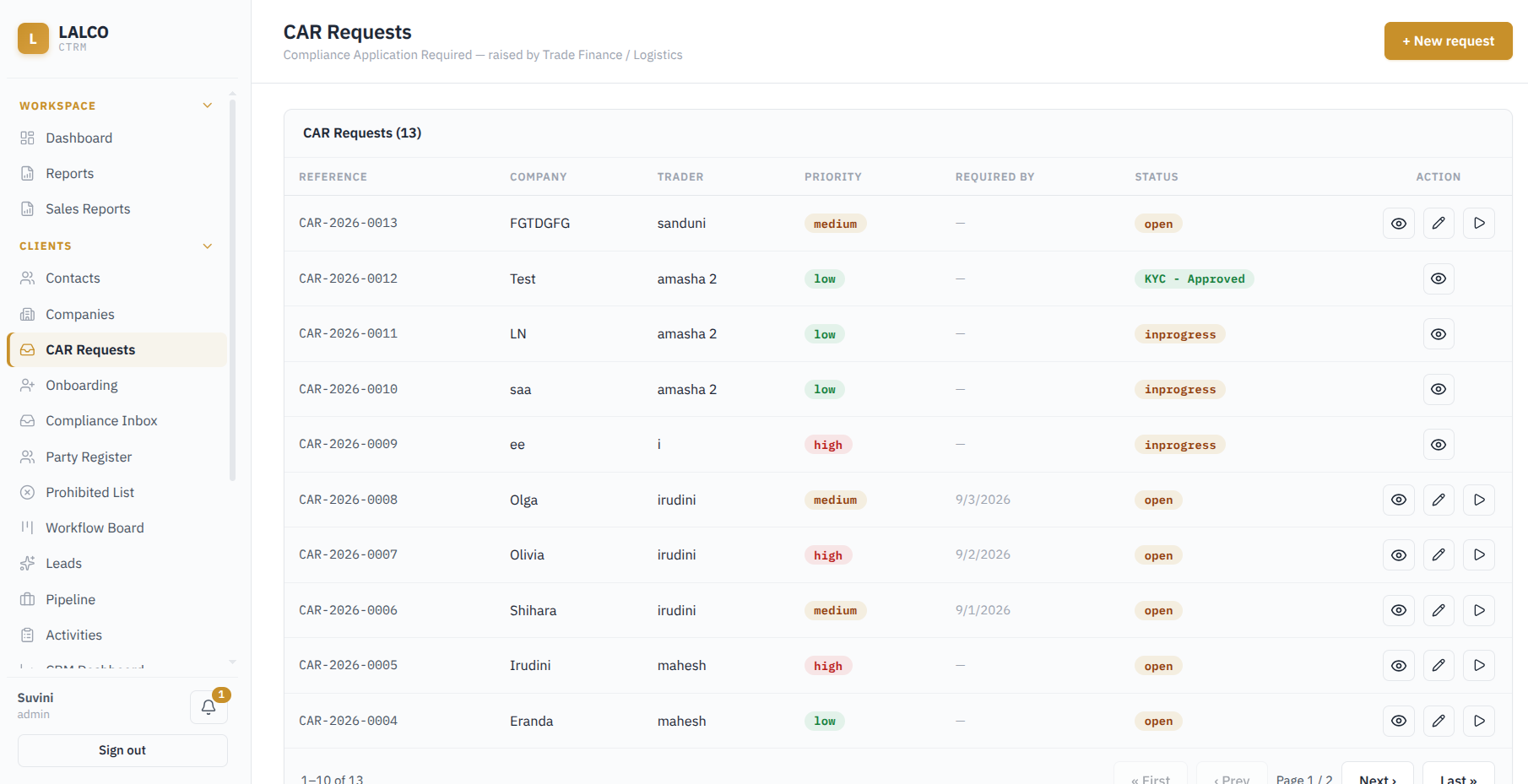
- Reference – System-generated CAR request reference.
- Company – Company for which the compliance request is raised.
- Trader – Trader associated with the request.
- Priority – Request priority (Low, Medium, High).
- Required By – Target date for completion.
- Status – Current request status, such as Open, In Progress, or KYC – Approved.
- Actions – Allows the user to view the request and, depending on its status, edit CAR request and start CAR request.
New CAR requests
Allows a CAR request to be raised for a company and assigned to the responsible trader. The request captures the business requirement, priority, and required completion date before being submitted for further processing.
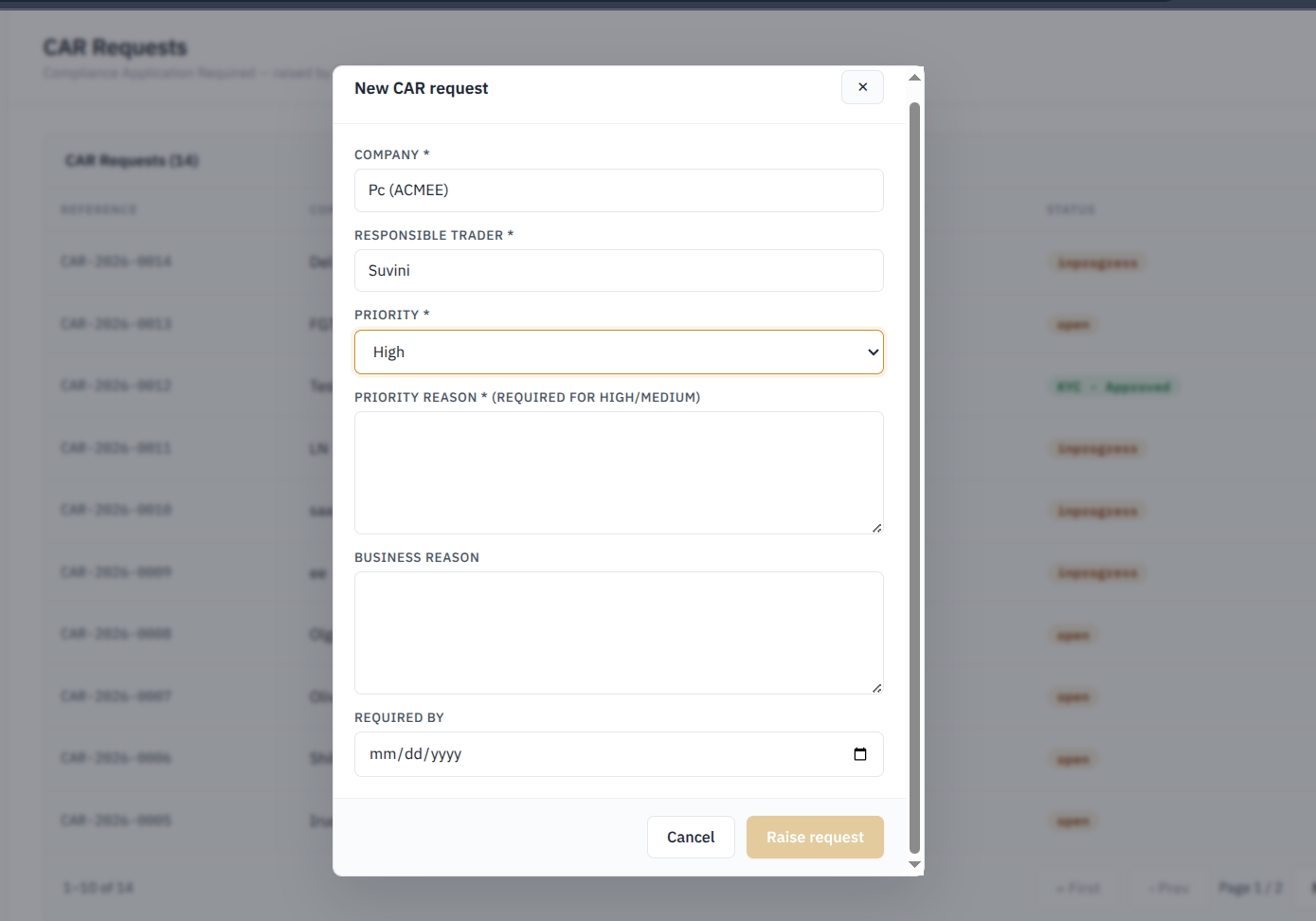
- Company - Search and select the company for which the CAR request is being raised. Required
- Responsible Trade - Select the trader responsible for the request
- Priority - Urgency of the request. Required
- Priority Reason - Required when priority is set to Medium or High. A reason must be entered why the requests . Required
- Business Reason - Provides the business justification or reason for raising the CAR request.
- Required By - Specifies the date by which the request is required to be completed.
Edit a CAR request
Users can edit an existing CAR request while it is still open
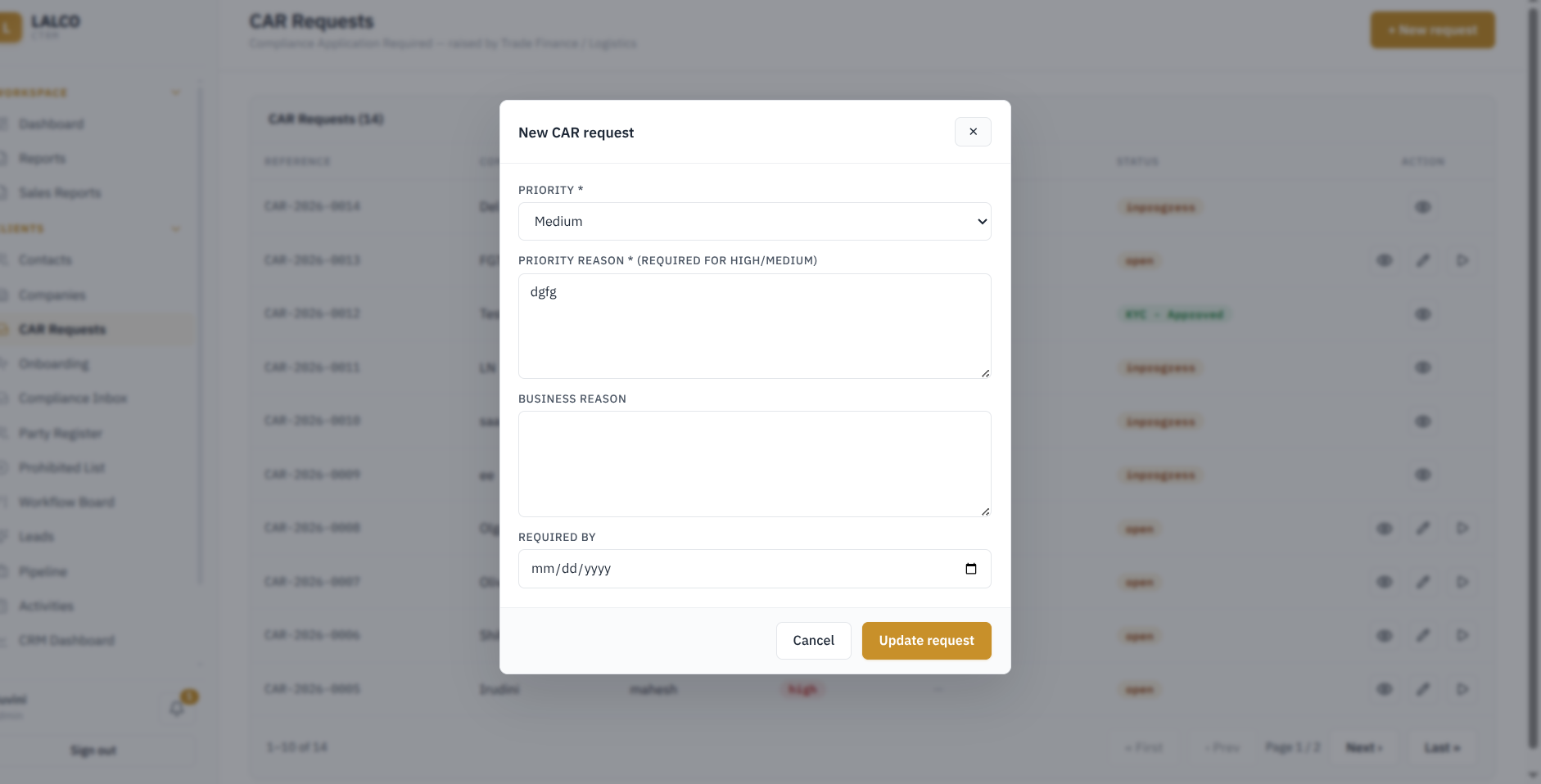
Fields that can be edited
- Priority – Low, Medium, or High.
- Priority Reason – Mandatory when Medium or High priority is selected.
- Business Reason – Business justification for the CAR request.
- Required By – Target date by which the compliance review is required.
Start CAR Request - New Onboarding Lead
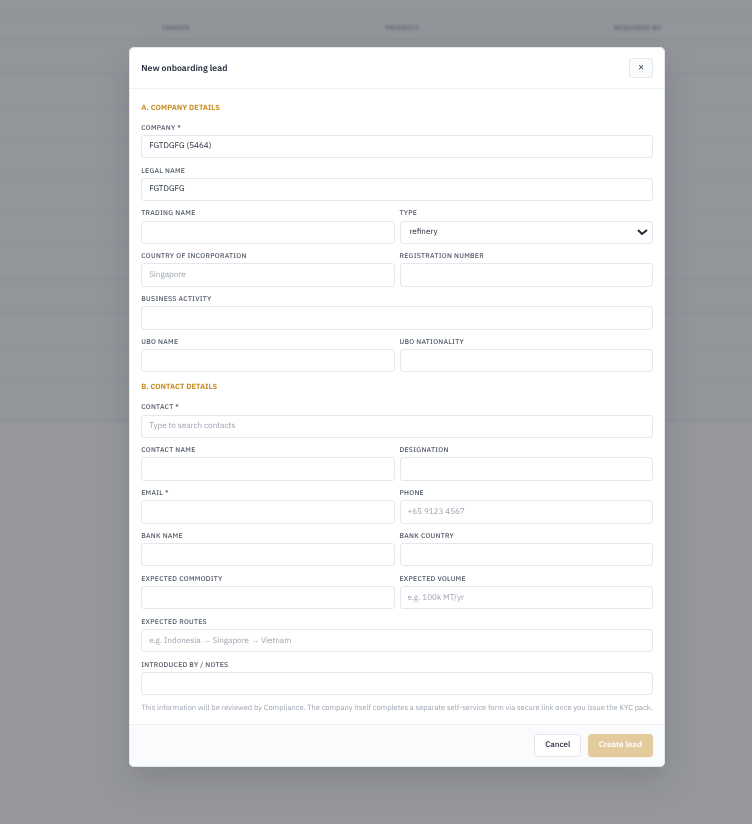
A. Company Details
- Company – Selects the company. Required.
- Legal Name – Company’s registered legal name.
- Trading Name – Company’s trading/business name.
- Type – Company type, such as refinery, supplier, customer, etc.
- Country of Incorporation – Country where the company is incorporated.
- Registration Number – Company registration number.
- Business Activity – Main business activity of the company.
- UBO Name – Name of the Ultimate Beneficial Owner.
- UBO Nationality – Nationality of the Ultimate Beneficial Owner.
B. Contact Details
- Contact – Selects the contact associated with the company. Required
- Contact Name – Name of the selected contact.
- Designation – Contact’s job title/role.
- Email – Contact’s email address. Required
- Phone – Contact’s phone number.
- Bank Name – Company/contact bank information.
- Bank Country – Country of the bank.
- Expected Commodity – Commodity the company is expected to trade.
- Expected Volume – Estimated trading volume.
- Expected Routes – Expected trading/shipping routes.
- Introduced By / Notes – Details of who introduced the company or any additional notes.
The lead information is first checked by the Compliance team. After that, the company receives a secure link to complete the required KYC form and submit its details for review.
2.4 Onboarding
The Onboarding module is used to manage potential companies before they become approved counterparties. It helps track leads through the early sales, onboarding, and KYC stages.

Filters
- Search – Finds leads using the legal name, trading name, or email.
- Status – Filters leads according to their current onboarding status.
- Country Risk – Filters leads based on the risk level associated with their country.
Leads information displayed
- Legal Name – Official name of the potential company.
- Type – Counterparty type, (eg: - customer, supplier, or terminal.)
- Country – Country associated with the lead.
- Risk – Indicates the country risk result.
- Primary Contact – Main contact person associated with the lead.
- Status – Shows the current stage of the onboarding process.
Status of onboarding leads
- Draft– The company is still a potential counterparty and has not yet moved through the KYC process.
- KYC Sent – The KYC request has been sent and the lead is progressing through onboarding. (documents are expected for review)
- KYC Submitted – The requested KYC information or documents have been submitted and are ready for review.
- Returned – The submitted KYC information has been sent back because corrections, missing information, or additional documents are required.
Onboarded – The company has successfully completed the onboarding process and has been accepted as a counterparty.
- Rejected – The lead has been rejected during the onboarding process.
General flow of a lead:
Prospect → KYC Sent → KYC Submitted → Onboarded
If there is an issue with the submitted information:
KYC Submitted → Returned → Corrected/Resubmitted
If the lead is not approved:
KYC Submitted → Rejected
Country Risk
- OK
- High Risk
- Banned
- Unknown
2.5 Compliance Inbox
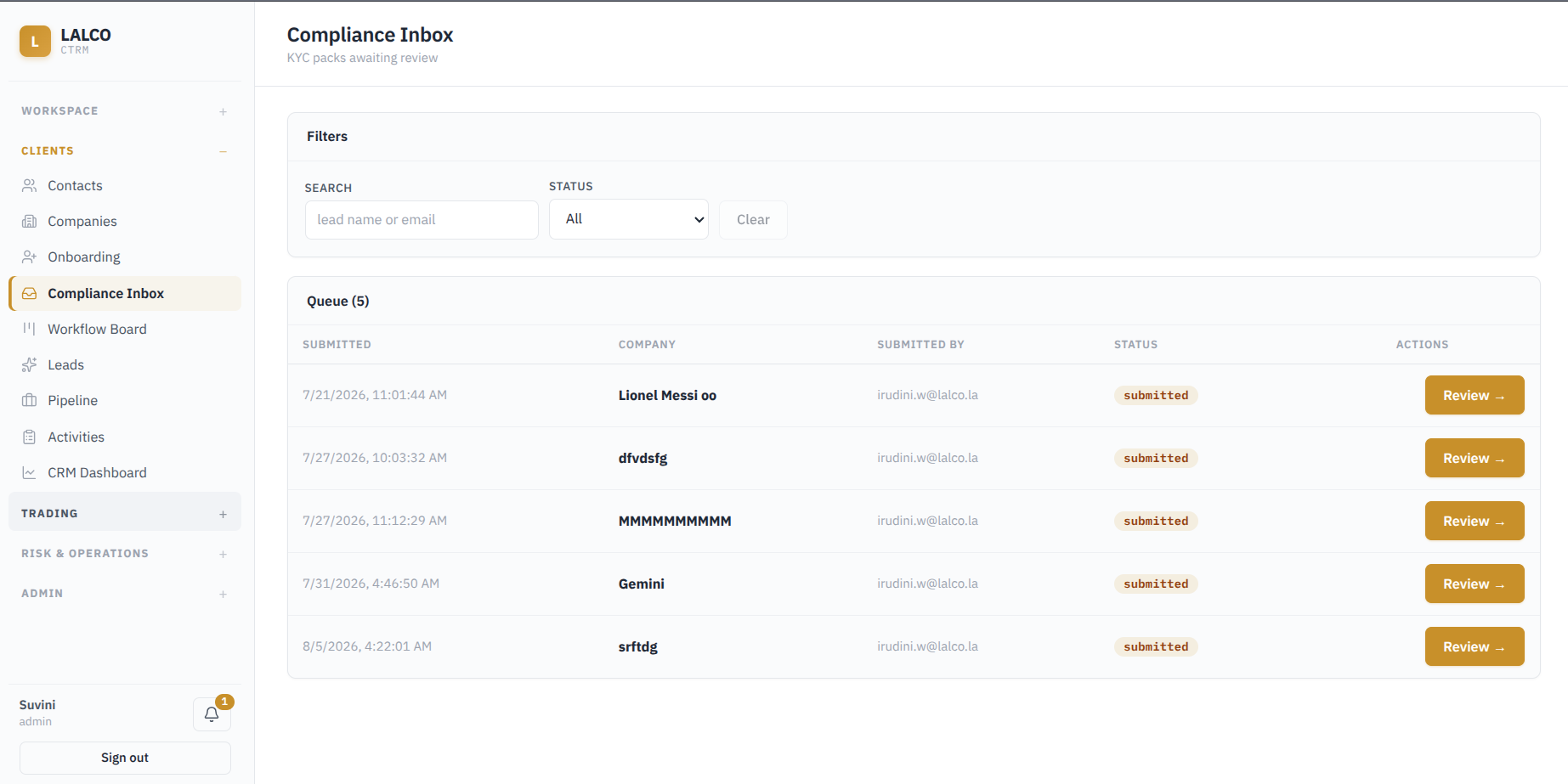
Used to review KYC submissions that haved been submitted and sent for compliance checking.
Filters
- Search based on Lead name and email
- Status based on current review status (submitted, Under review)
Statuses
- Submitted
- Under review
Details displayed
- Submitted
- Company
- Submitted by
- Status
- Actions (Review)
Review KYC Pack
The review page shows the KYC submission details, uploaded documents, company information, risk indicators, and the available compliance actions.
KYC Invitation and Submission Details

- Invitation Status – Shows whether the KYC invitation email was sent.
- Sent To – Email address to which the KYC pack was sent.
- Expiry Date – Date and time when the KYC link expires.
- Signed – Shows who signed the KYC submission and when.
- Submitted – Date and time the KYC pack was submitted.
- Reviewed – Shows when and by whom the submission was reviewed.
- Resend Email – Allows the KYC invitation to be sent again when required.
Document Checklist
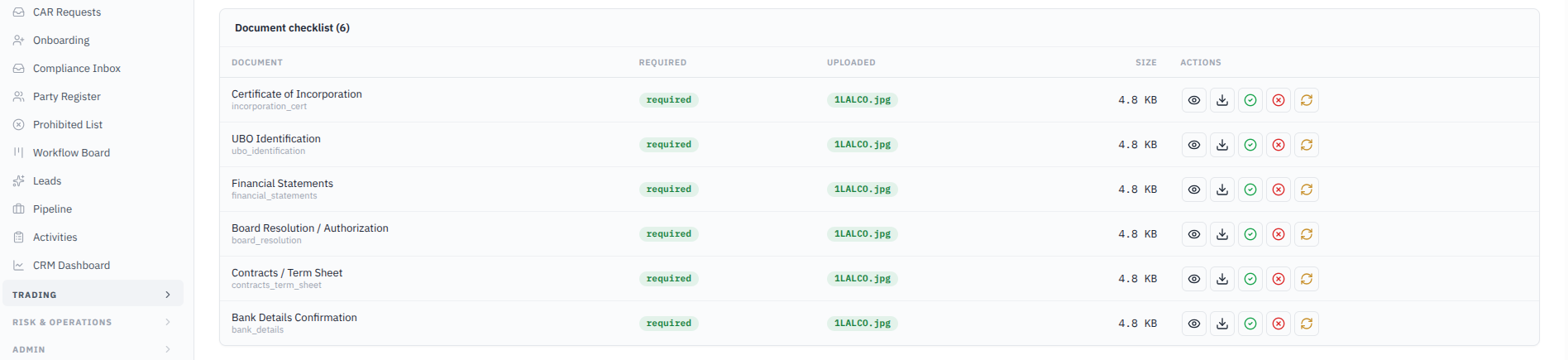
The Document Checklist shows the documents required for the KYC review and the files uploaded by the company and allows Compliance to view, download, accept, reject, or request the re-submission of each uploaded KYC document.
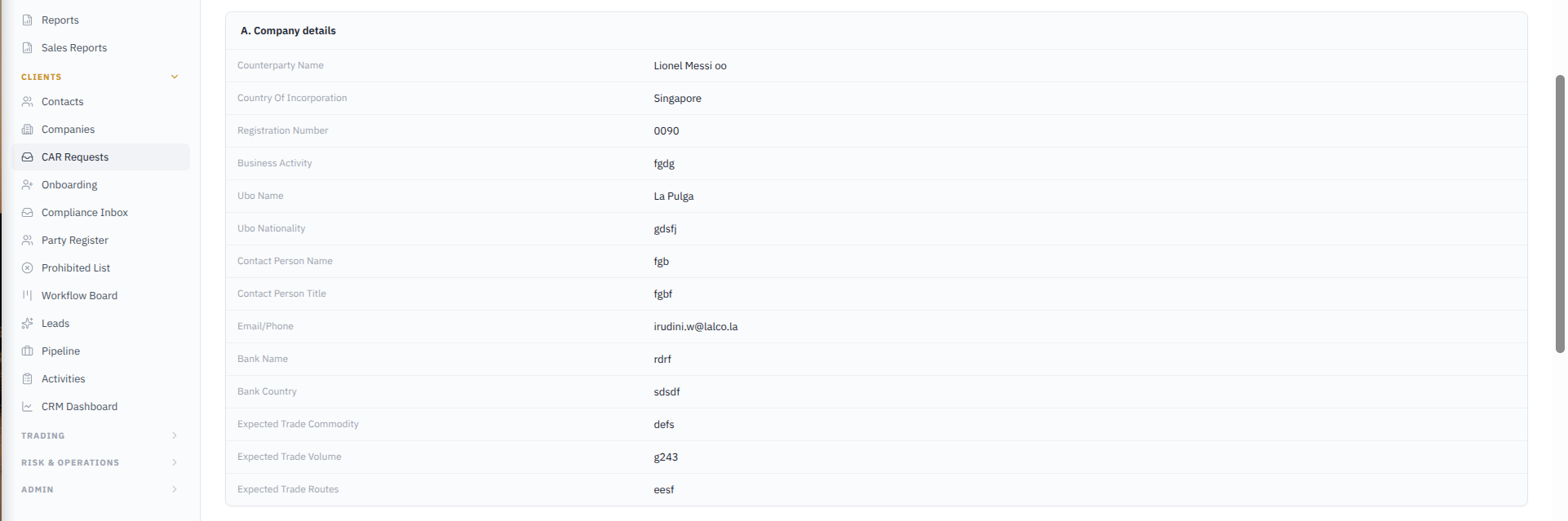
A. Company details
B. Risk Indicators
The reviewer evaluates each compliance risk by selecting Yes or No and provides an explanation where a risk is identified.

B.Risk Reviews & approval
Used to assess potential compliance and transaction risks.
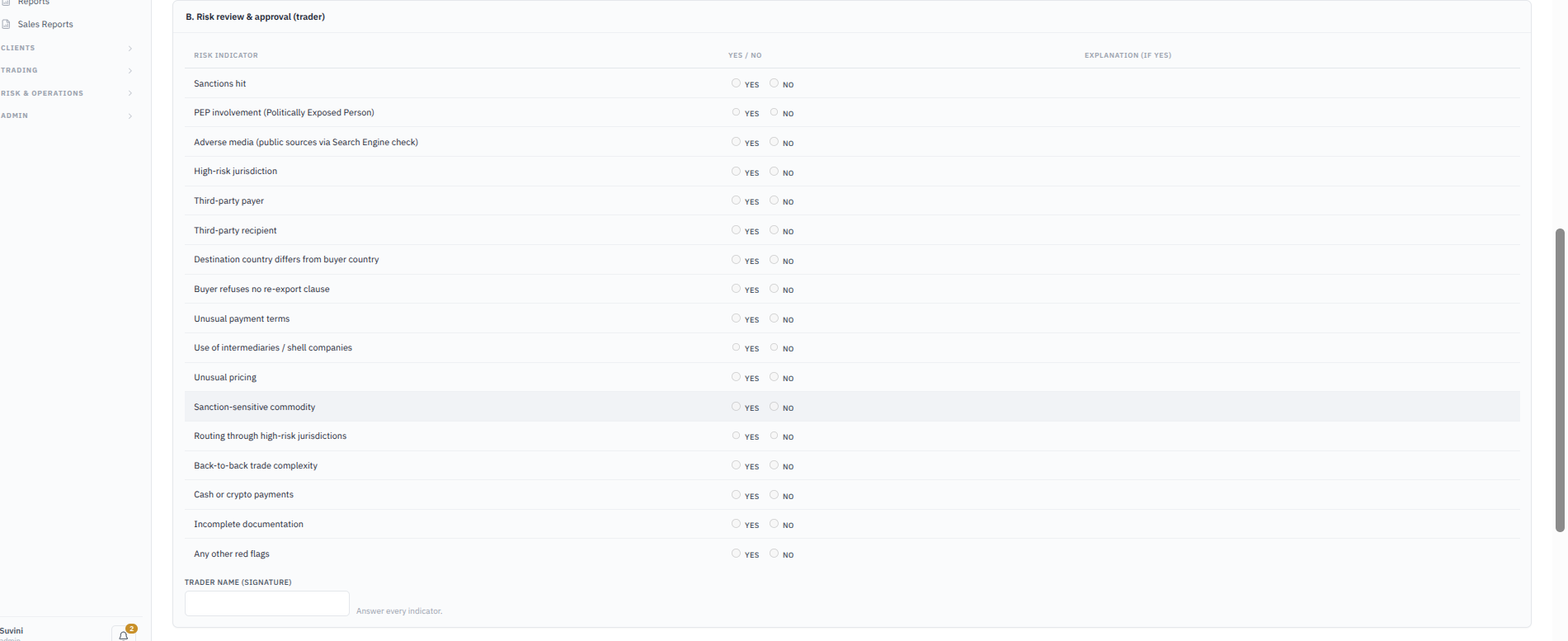
Where a risk indicator is identified, an explanation may be required. After all indicators have been reviewed, the trader enters their name/signature and selects Sign and submit risk review.
Internal submission form 
Used to review and record internal company information such as legal entity name, country of incorporation, registration number, business activity, UBO details, bank details, expected commodity, expected volume, and expected routes.

- Copy from counterparty form – Copies the submitted counterparty information into the internal form.
- Save internal form – Saves the internal review information.
Proposed Commodities
The Proposed Commodities section shows the commodities the company is expected to trade.

For each proposed commodity, Compliance can: Approve and Reject the commodity.
Compliance Decision
After reviewing the KYC information, documents, risk indicators, internal form, and proposed commodities, Compliance can take one of the following actions:
- Approve & Onboard - Approves the KYC and completes the onboarding process.
- Return for changes - Sends the submission back so corrections can be made.
- Request More info - Requests additional information before a final decision is made.
- Require EDD - Moves the case to Enhanced Due Diligence for further review.
- Reject - Rejects the KYC/onboarding application.
- Withdraw - Stops the application from proceeding further

2.6 Workflow Board
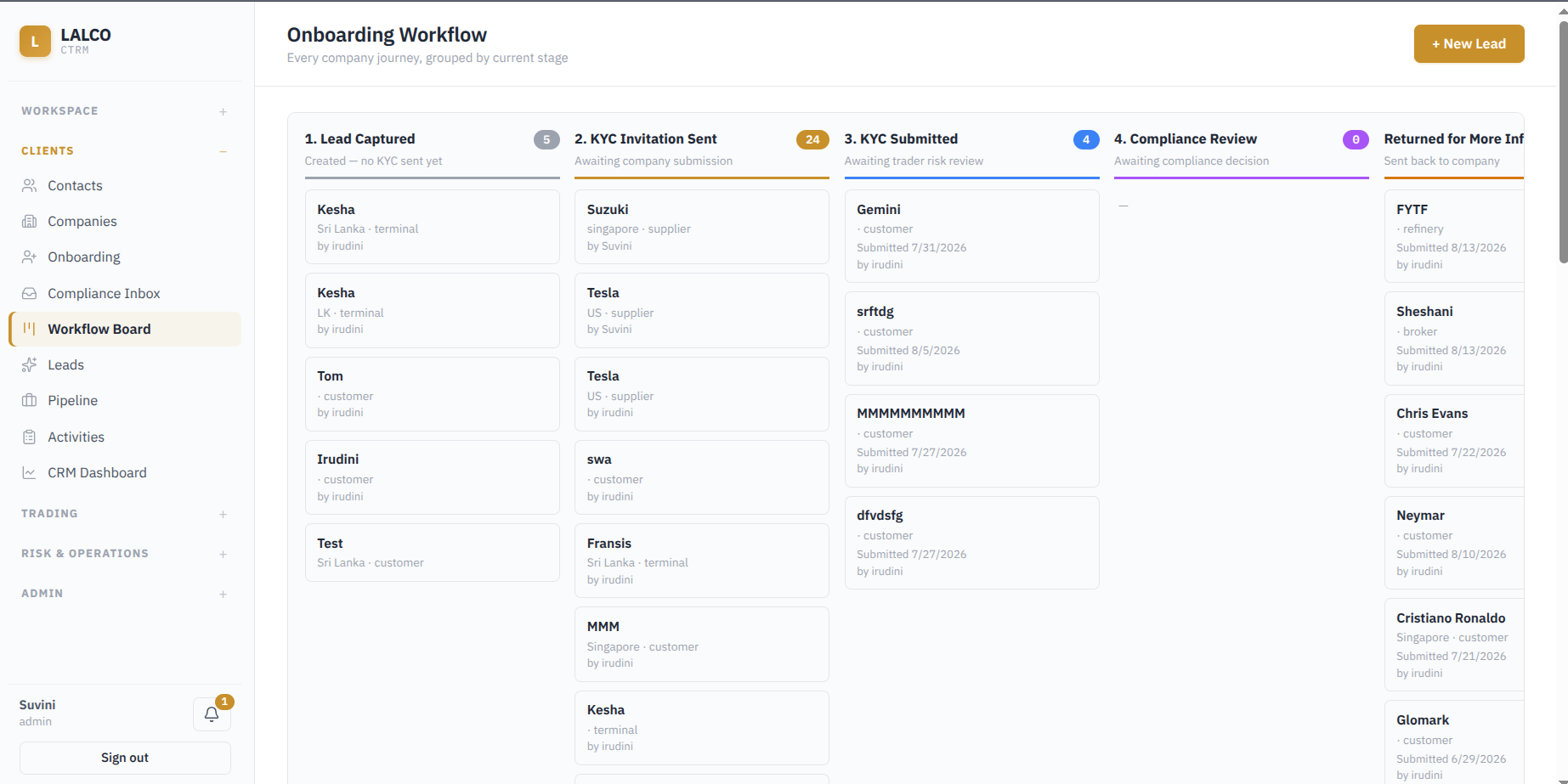
The Workflow Board gives a visual view of where each company currently stands in the onboarding process. Companies are grouped into columns based on their current stage
Stages
1. Lead Captured – The lead has been created, but the KYC invitation has not yet been sent.
2. KYC Invitation Sent – The KYC request has been sent and the company is expected to complete and submit it.
3. KYC Submitted – The company has submitted the KYC information and it is waiting for further review.
4. Compliance Review – The submitted KYC information is being reviewed by the Compliance team.
Returned for More Information – The submission has been sent back to the company because additional information or corrections are required.
2.7 Leads
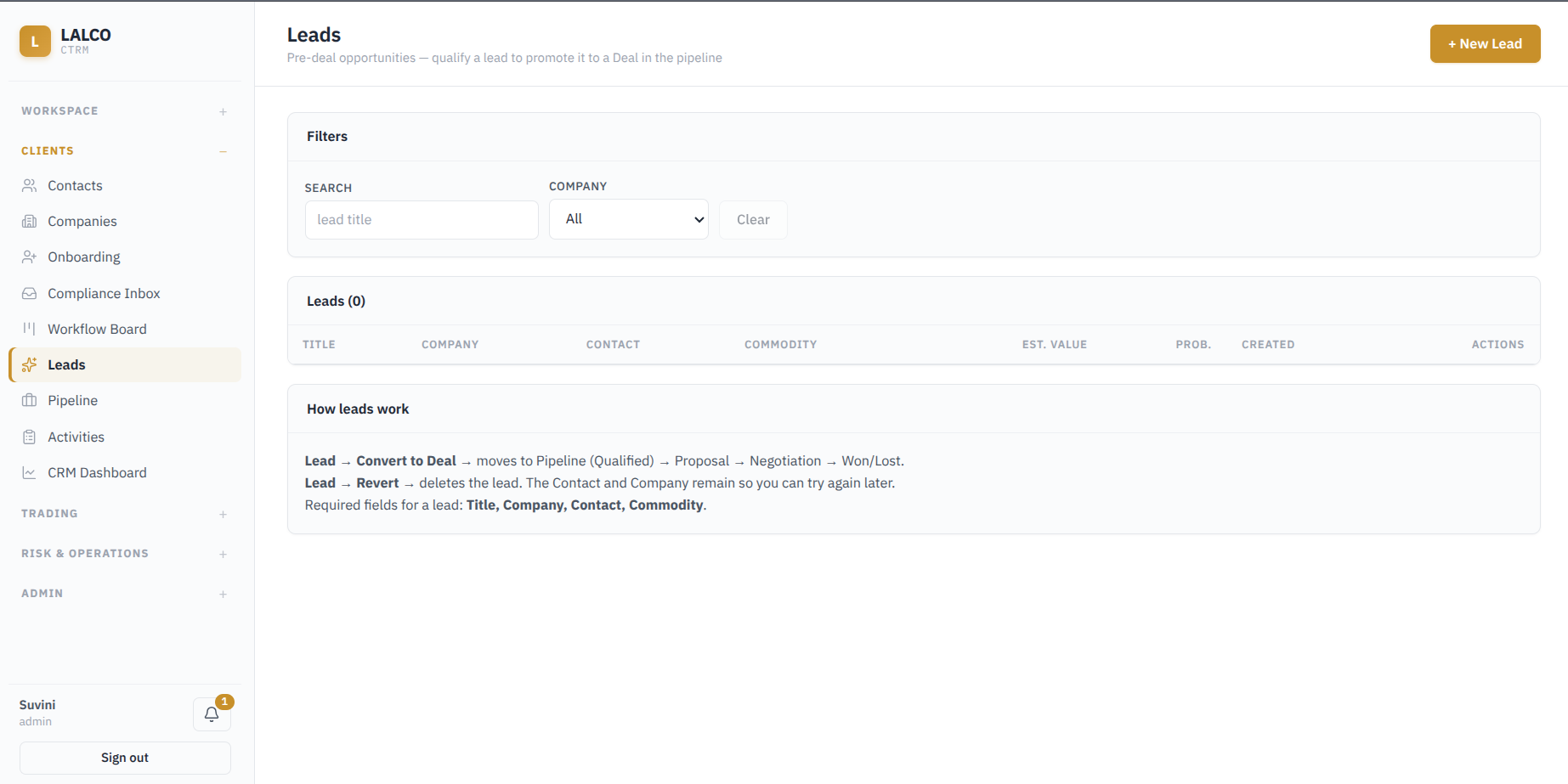
Used to manage potential trading opportunities before they become actual deals. A lead represents an opportunity linked to a company, contact, and commodity.
Filters
- Search a lead using the lead title
- Company
Lead information
- Title
- Company
- Contact
- Commodity
- Estimated value (expected value of the opportunity)
- Probability (chance of the opportunity progressing)
- Created
Convert Lead To Deal
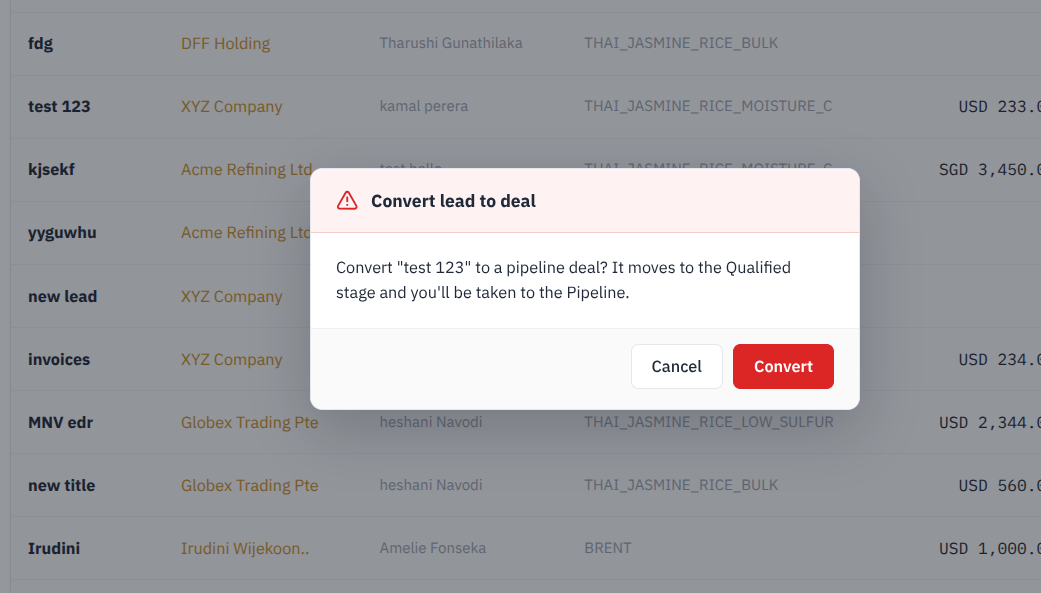
When a lead becomes a qualified business opportunity, the user can select Convert to Deal.
- The system asks for confirmation before converting the lead.
- Once confirmed, the lead is moved to the Pipeline as a deal.
- The new deal starts at the Qualified stage.
- After conversion, the user is redirected to the Pipeline to continue managing the deal.
How Leads Work
Possible trading opportunity→Lead → Convert to Deal → Qualified → Proposal → Negotiation → Won/Lost
Lead → Revert : Deletes the lead. The Contact and Company remain so you can try again later.
Create a new lead
The New Lead form is used to record a potential trading opportunity before it becomes a deal.
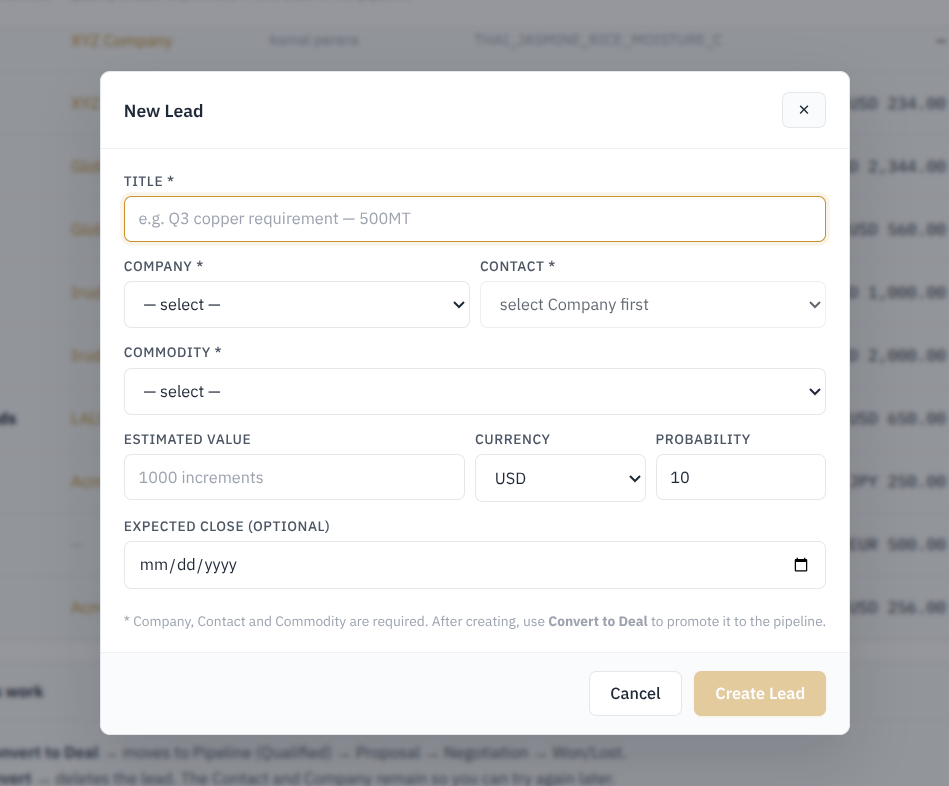
- Title* – Short description of the opportunity, for example, Q3 Copper Requirement – 500MT. (Required)
- Company* – Select the company related to the opportunity. (Required)
- Contact* – Select the relevant contact person from the chosen company. (Required)
- Commodity* – Select the commodity involved in the opportunity. (Required)
- Estimated Value – Enter the expected value of the opportunity.
- Currency – Select the currency used for the estimated value.
- Probability – Enter the estimated chance of the opportunity becoming a deal.
- Expected Close – Optional date indicating when the opportunity is expected to be completed.
The Leads page may also display deals that were created directly in the Pipeline with the Lead stage. These records are already deals and therefore cannot be converted again. Only pre-deal leads can use the Convert to Deal function.
2.8 Pipeline
Used to track trading opportunities after they have been converted into deals. It shows how deals progress through different sales stages until they are either won or lost.
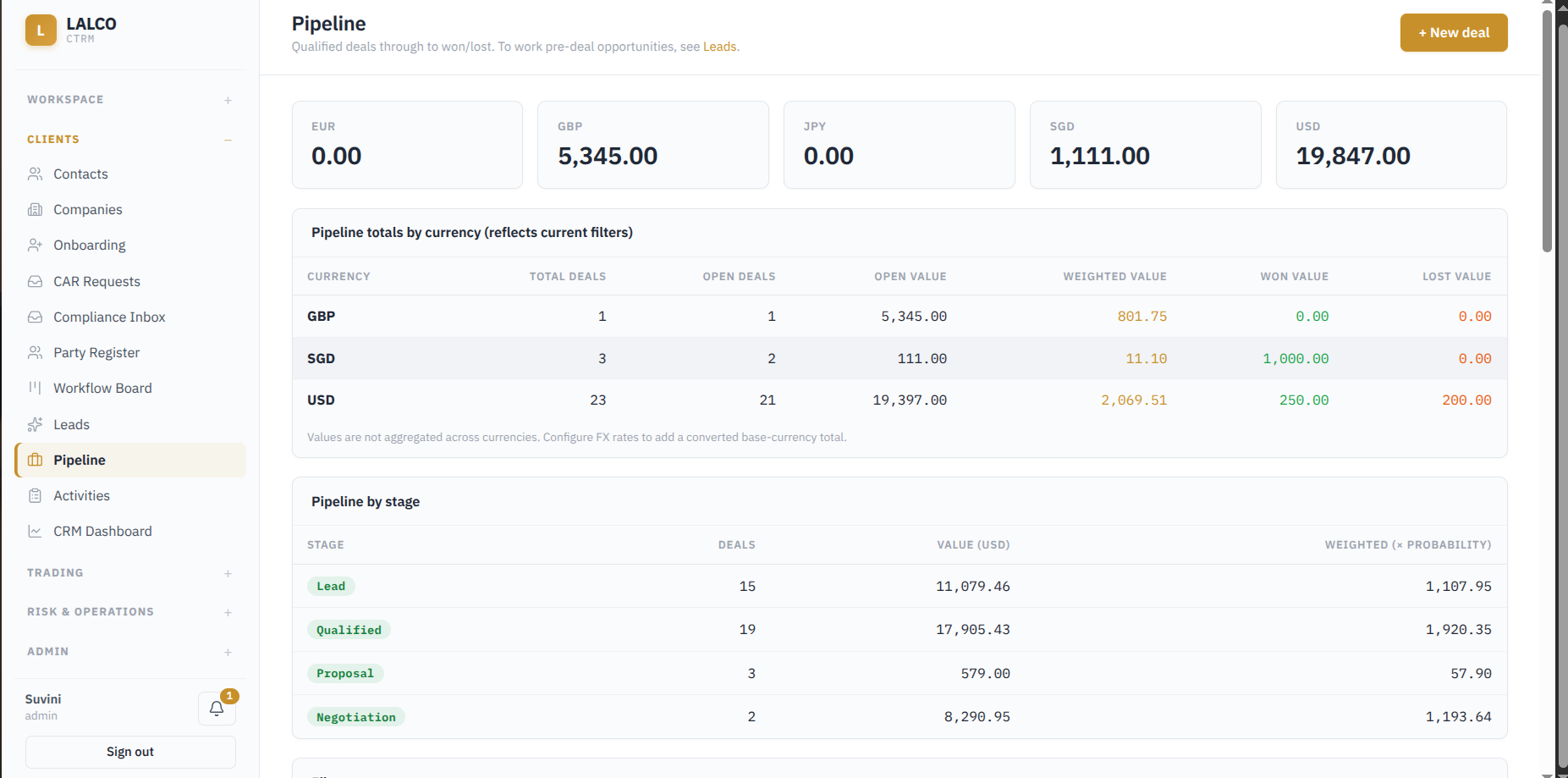
Create a new deal
Allows a deal to be created directly in the Pipeline without first creating it as a Lead.
Pipeline deals can be added by :
1. Lead → Convert to Deal → Pipeline
2. New Deal → Create directly in Pipeline.
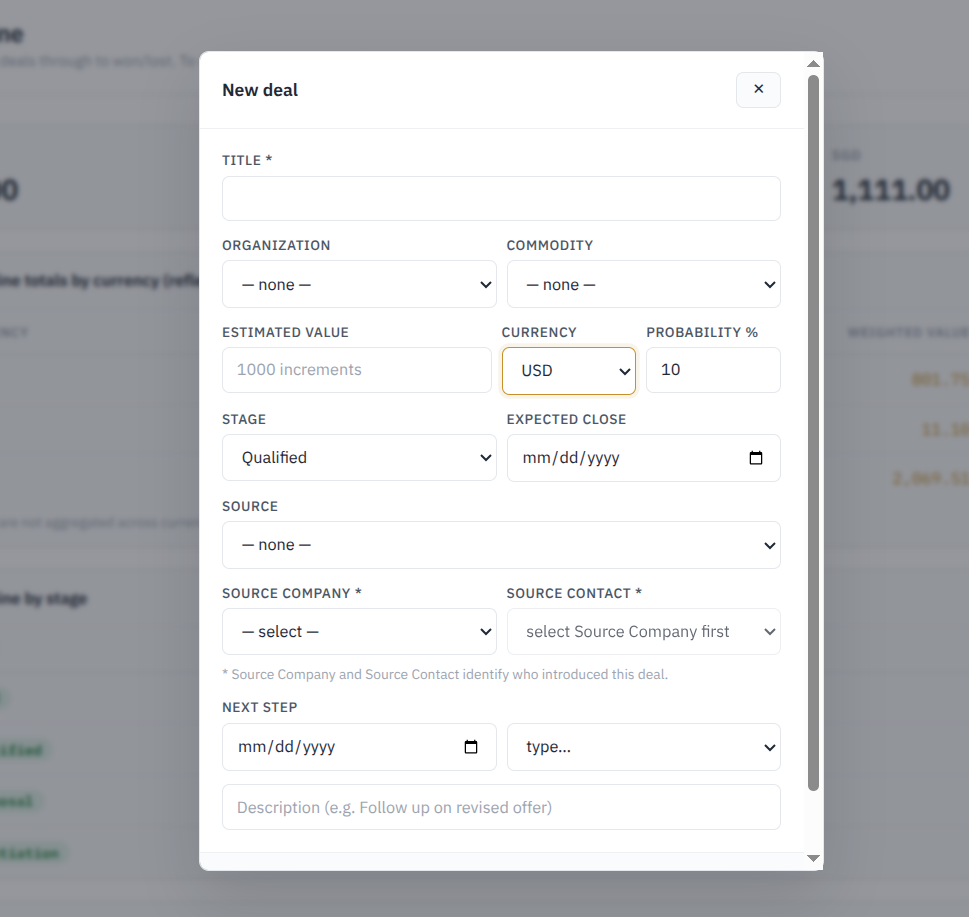
Deal Details
- Title* – Name or short description of the deal. (Required)
- Organization – Company or counterparty related to the deal.
- Commodity – Commodity involved in the deal.
- Estimated Value – Expected monetary value of the deal.
- Currency – Currency used for the estimated value.
- Probability % – Estimated chance of successfully winning the deal.
- Stage – Current stage of the deal
- Expected Close – Expected date for the deal to be completed.
Source Information : - Source – Indicates how the deal originated.
- Source Company* – Company that introduced or referred the deal. (Required)
- Source Contact* – Contact person from the source company who introduced the deal. (Required)
The Source Company and Source Contact therefore help identify where the business opportunity came from.
Next Step :
The user can also record the next planned action for the deal:
- Date – When the next action should take place.
- Type – Type of follow-up/action.
- Description – Additional details, such as “Follow up on revised offer.”
Pipeline view (Pipeline Summary)
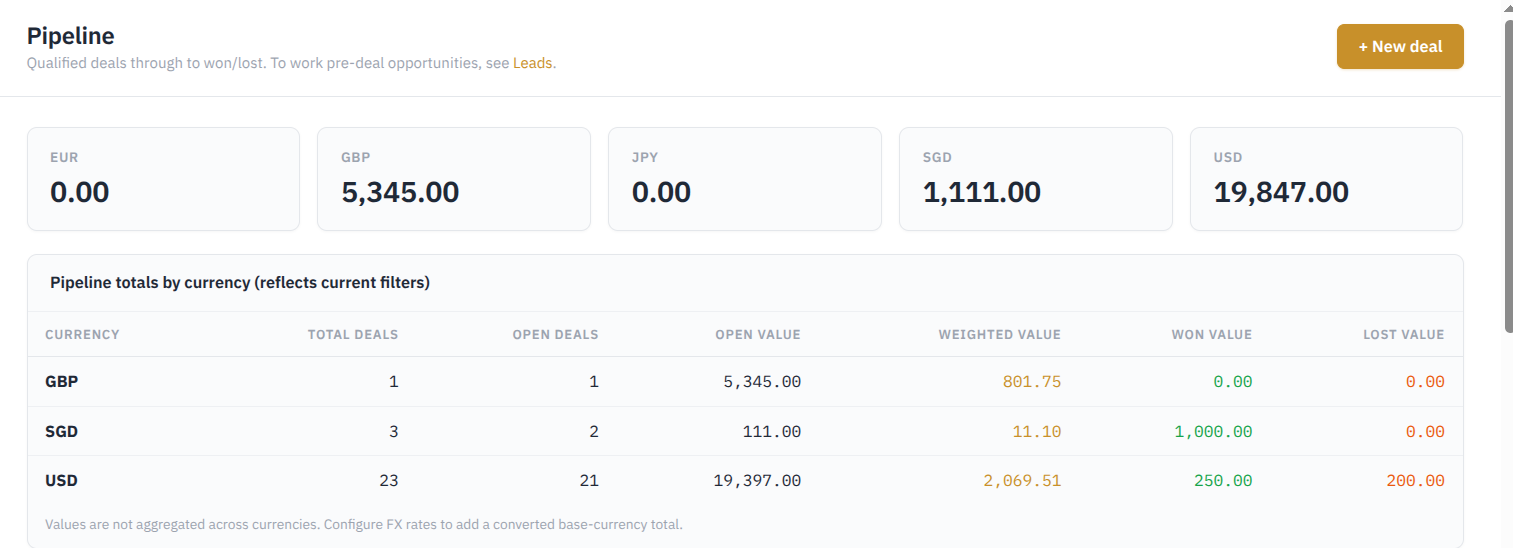
1.Pipeline value by currency :
- EUR
- GBP
- JPY
- SGD
- USD
(Each currency shows its own pipeline value so that amounts from different currencies are not mixed together.)
2.Pipeline Totals by Currency
For each currency, the system displays:
- Total Deals – Total number of deals recorded in that currency.
- Open Deals – Number of deals that are still in progress.
- Open Value – Total value of all open deals.
- Weighted Value – Expected value of open deals after considering their probability of success.
- Won Value – Total value of deals marked as Won.
- Lost Value – Total value of deals marked as Lost.
Calculations
1. Open value : calculated by adding all values of the deals that are still open
Open Value = Sum of all Open Deal Values
2. Weighted Value : Considers both the value and its probability of success
Weighted Value = Deal Value × Probability %
3. Won Value :
Won Value = Sum of all deals marked as Won
4. Lost Value :
Lost Value = Sum of all deals marked as Lost
5.Total pipeline value by currency : Each currency includes the open, won, lost deal values
Total Pipeline Value = Open Value + Won Value + Lost Value
6. Total deals
Total Deals = Deals by pipeline stage + Leads
3.Pipeline Stages
The Pipeline groups deals according to their current stage:
Lead → Qualified → Proposal → Negotiation → Won / Lost
- Lead – Early stage of the deal.
- Qualified – The opportunity has been identified as a valid deal.
- Proposal – An offer or proposal is being prepared or presented.
- Negotiation – Deal terms are being discussed and finalized.
- Won – The deal has been successfully secured.
- Lost – The deal was unsuccessful.
For each active stage the system displays Deals, Values, Weighted Value
4. Pipeline Deal Information
For each deal, the system shows:
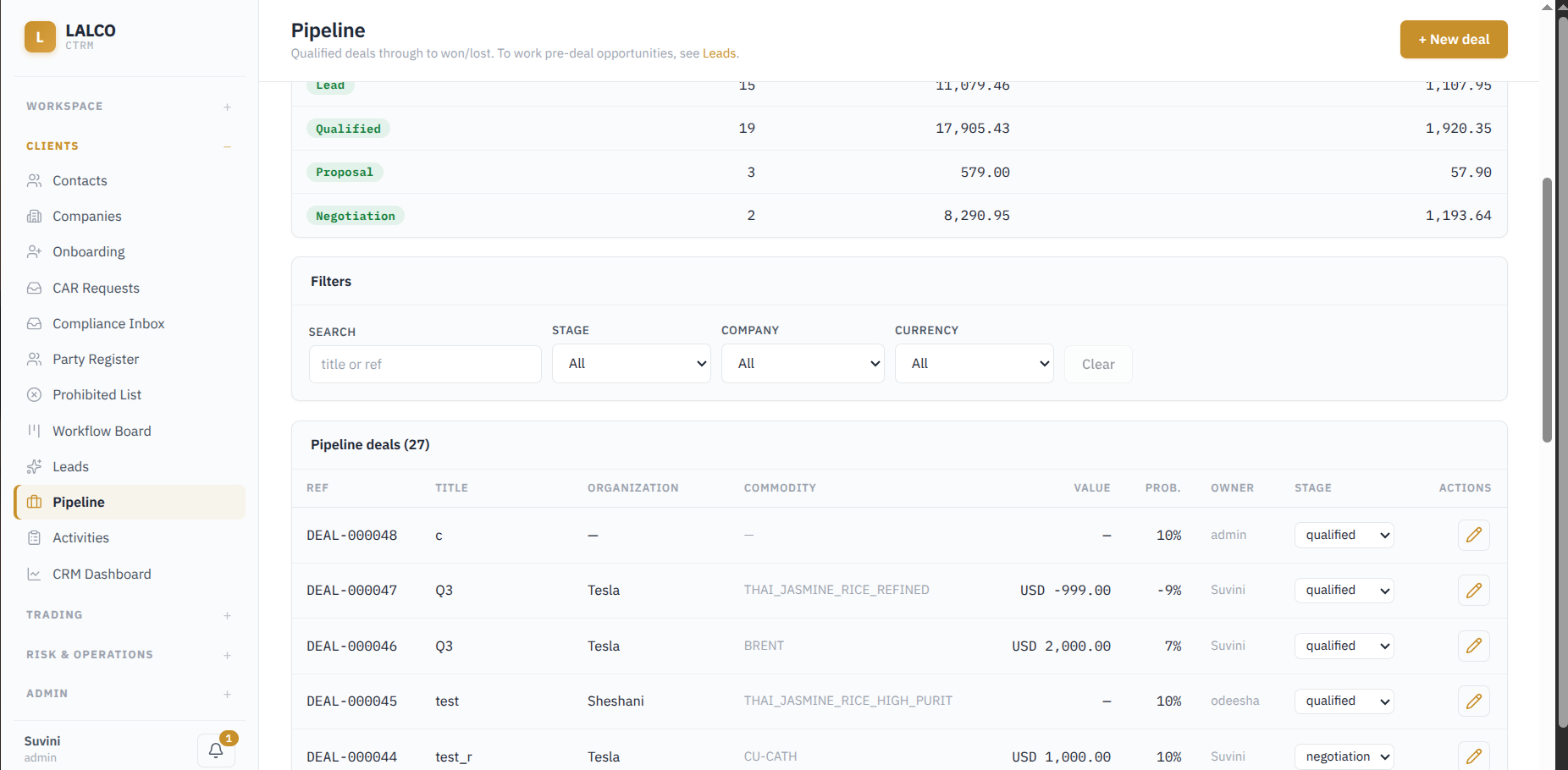
- Ref – Unique reference number assigned to the deal.
- Title – Name or short description of the deal.
- Organization – Company associated with the deal.
- Commodity – Commodity involved.
- Value – Estimated deal value together with its currency.
- Prob. – Probability of successfully winning the deal.
- Owner – User responsible for the deal.
- Stage – Current stage of the deal.
- Actions – Allows the deal to be edited.
Filters
- Search by title and ref
- Stage
- Company
- Currency
2.9 Activities
The Activities module is used to manage follow-up activities such as tasks, calls, meetings, messages, emails, and reminders. It helps users keep track of what needs to be done, when it is due, and who is responsible
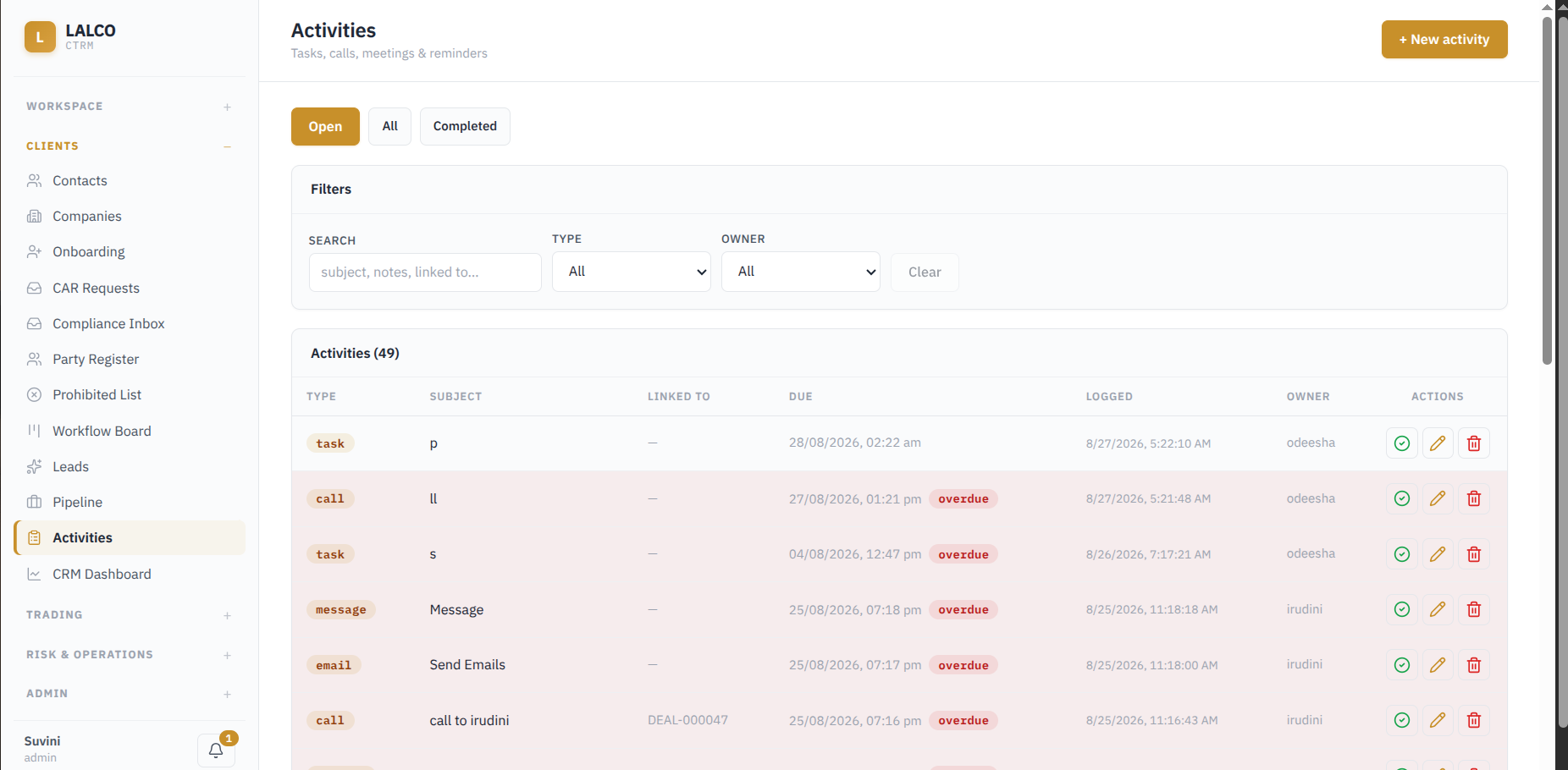
Activity Views
- Open – Shows activities that are still pending.
- All – Shows both open and completed activities.
- Completed – Shows activities that have already been completed.
Filters
- Search – Searches activities using the subject, notes, or linked record.
- Type – Filters activities by activity type.
- Owner – Filters activities according to the user responsible for them.
Activity Information
- Type – Type of activity, such as task, call, message, or email.
- Subject – Short description of the activity.
- Linked To – Shows the related record, such as a deal, where applicable.
- Due – Date and time by which the activity should be completed.
- Logged – Date and time the activity was created or recorded.
- Owner – User responsible for the activity.
- Actions – Allows the activity to be completed, edited, or deleted.
Overdue Activities
If an open activity passes its due date without being completed, the system marks it as Overdue.
Create New Activity
Used to record a new task, call, meeting, message, email, or other follow-up activity.
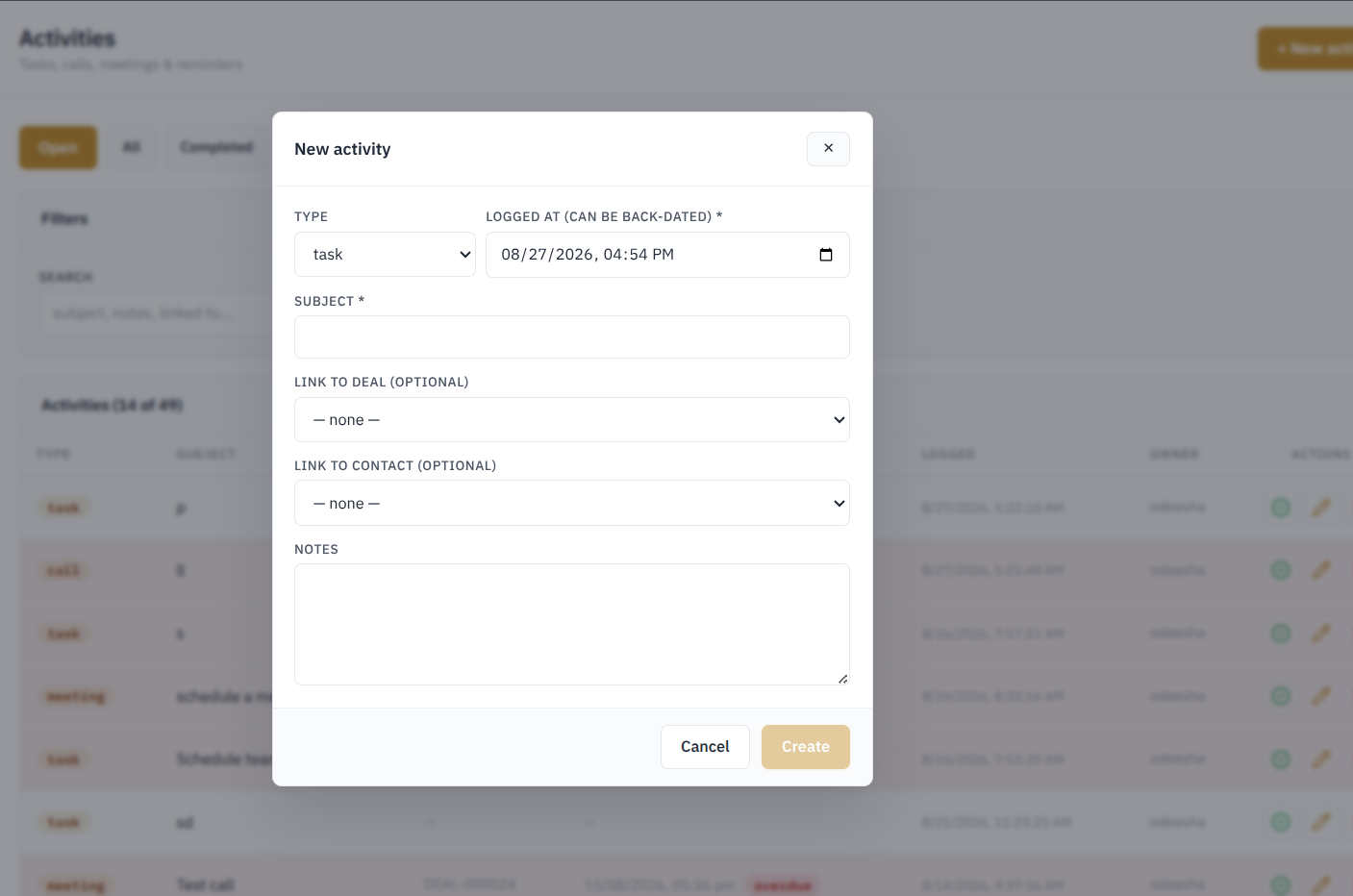
- Type – Select the type of activity.
- Logged At – Date and time the activity was recorded. This can also be back-dated if the activity happened earlier. Required
- Subject – Short description of the activity. Required
- Link to Deal – Connects the activity to a specific deal. Optional
- Link to Contact – Connects the activity to a specific contact. Optional
- Notes – Additional details about the activity.
Key Characteristic
Activities can be linked directly to a Deal or Contact, which makes it easier to track follow-ups related to a specific business opportunity or person.
Activity Notifications

When an activity is created and linked to a contact, the system uses the email address stored in the Contacts module to send the relevant activity notification to that contact.
The system also provides notifications/reminders for upcoming activities, for users keep track of scheduled follow-ups and activities that are approaching their due date.
If an activity passes its due date without being completed, it is shown as Overdue in the system.
Main Functions
- Create a new activity.
- Mark an activity as completed. (Which cannot be reverted back)
- Edit an existing activity.
- Delete an activity.
- Link an activity to a related record such as a deal.
2.10 CRM Dashboard
The CRM Dashboard provides an overall view of the sales pipeline, deal performance, and client-related activities in one place.
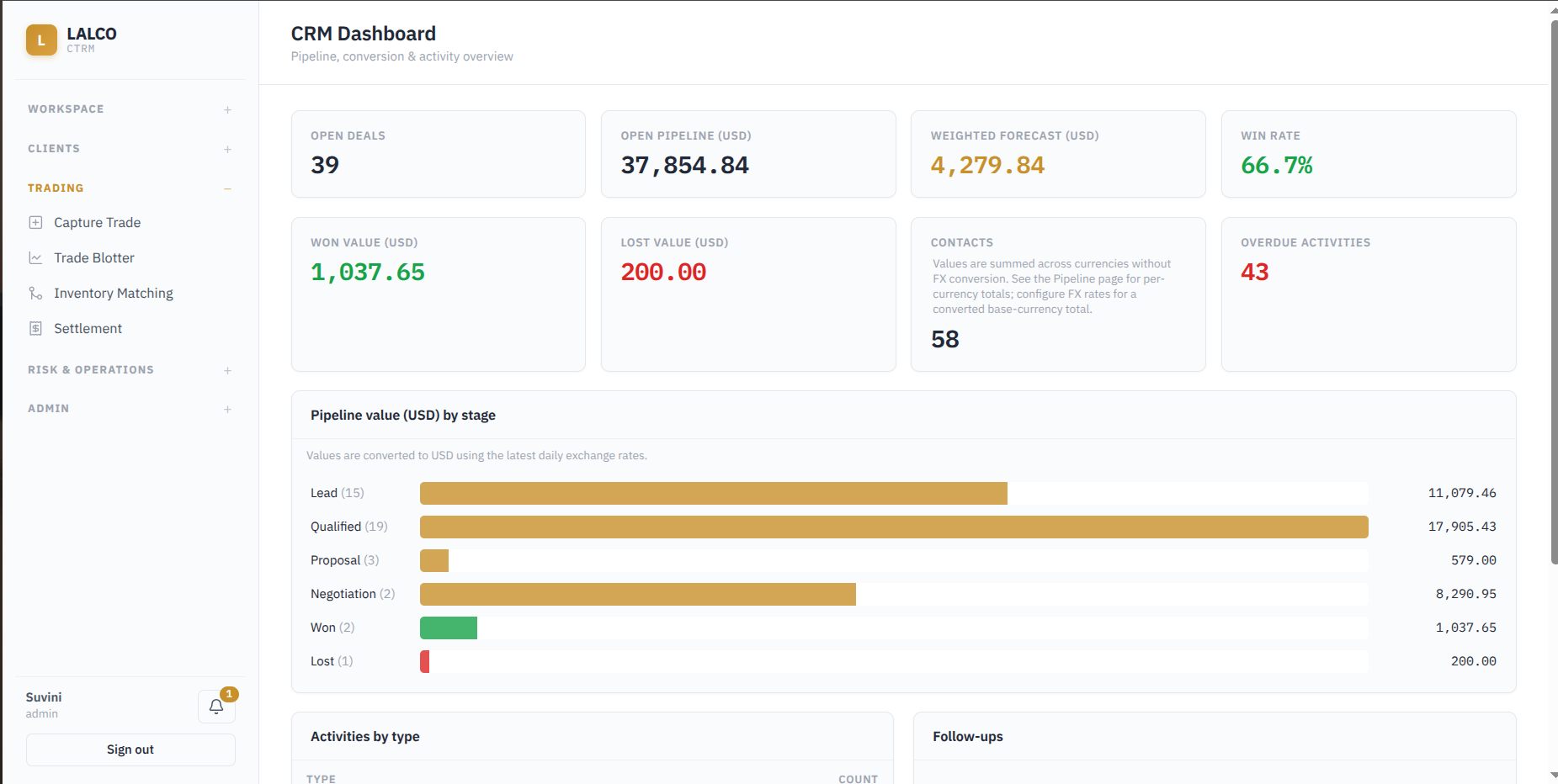
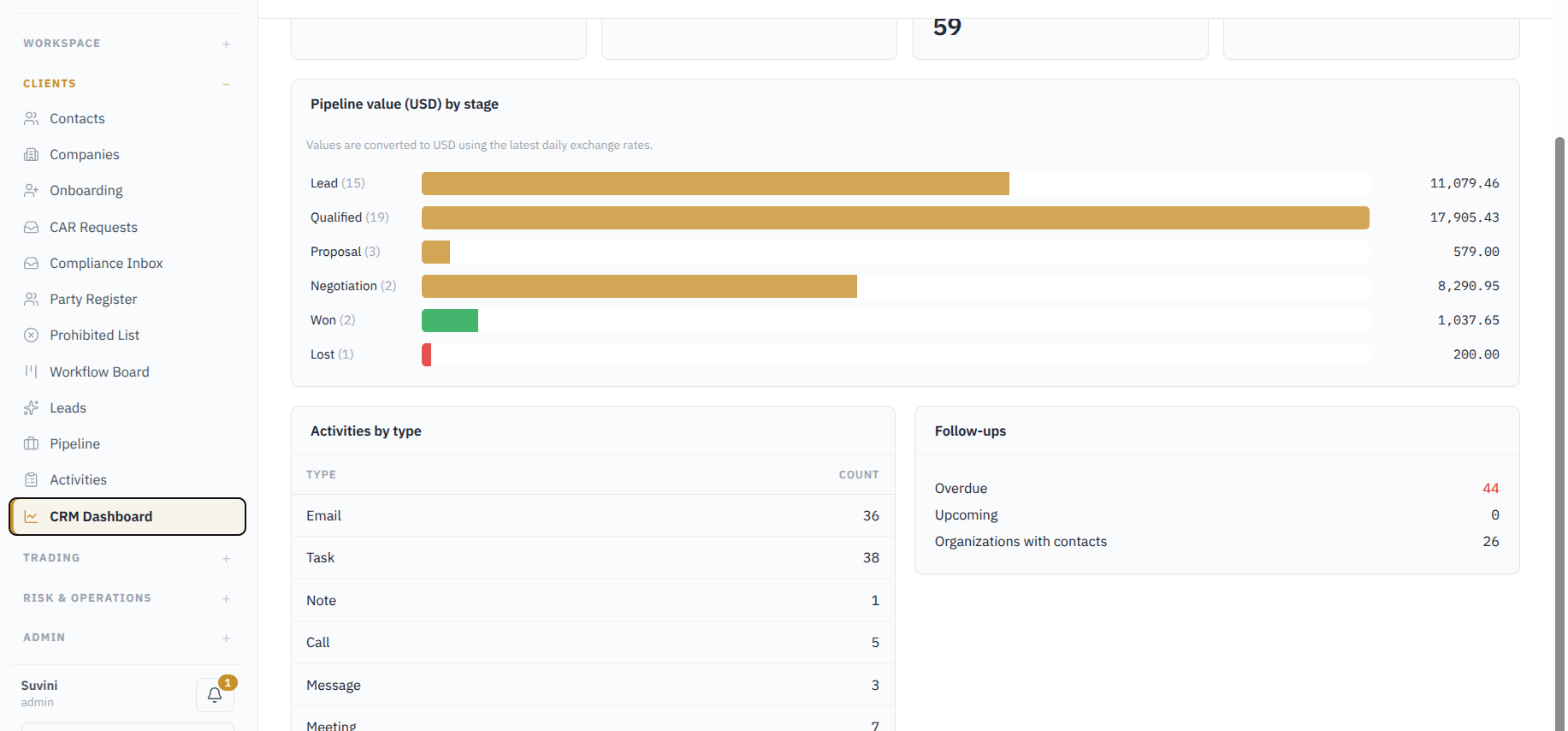
Information Displayed
- Open Deals – Number of deals that are still in progress.
- Open Pipeline (USD) – Total value of all open deals after converting them to USD.
- Weighted Forecast (USD) – Expected value of the open pipeline after considering the probability of each deal.
- Win Rate – Percentage of completed deals that were won.
- Won Value (USD) – Total value of deals marked as Won.
- Lost Value (USD) – Total value of deals marked as Lost.
- Contacts – Total number of contacts recorded in the CRM.
- Overdue Activities – Number of open activities that have passed their due date.
- Pipeline value by stage
- Activities by Type - CRM activities recorded under each activity (Email, Task, Note, Call, Message)
-
Follow-ups
The Follow-ups section gives a quick view of pending CRM actions and contact coverage.
- Overdue – Number of activities that have passed their due date and are still not completed.
- Upcoming – Number of activities that are scheduled for a future date.
- Organizations with Contacts – Number of organizations that currently have at least one contact linked to them.
Calculations
Win Rate = Won Deals ÷ (Won Deals + Lost Deals) × 100
3.Trading
The Trading section is used to record and manage commodity trades, review captured trades, match trades with inventory, and handle settlement activities.
3.1 Capture Trade
The Capture Trade module is used to enter a new Buy or Sell transaction into the CTRM system. Before the trade is recorded, the system performs the configured checks on the entered information.
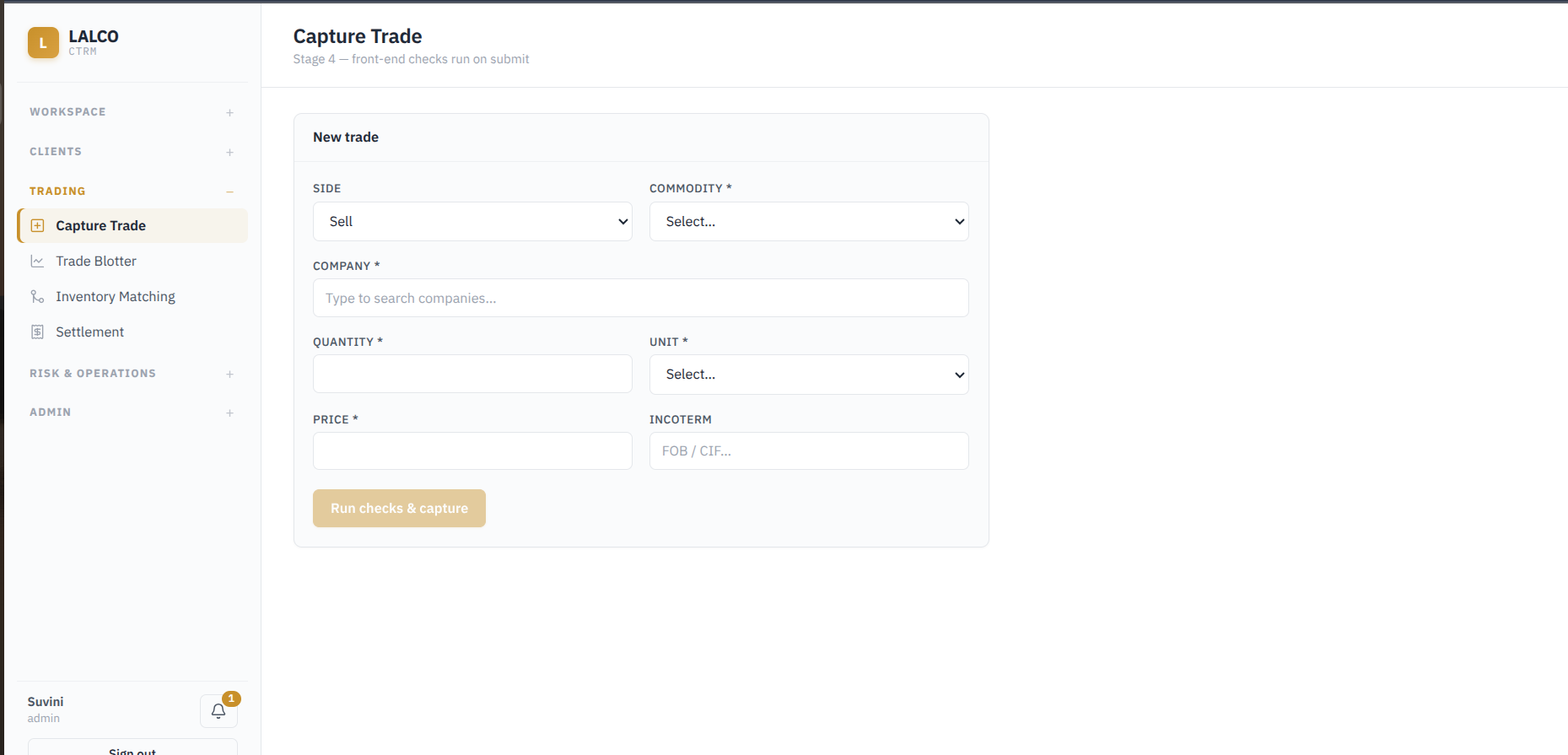
New Trade - Trade details
- Side – Indicates whether the trade is a Buy or Sell.
- Commodity – Commodity being bought or sold. Required
- Company – Counterparty involved in the trade. Required
- Quantity – Amount of the commodity being traded. Required
- Unit – Unit used to measure the quantity. Required
- Price – Agreed price of the commodity. Required
- Incoterm – Defines the agreed delivery responsibilities and terms between the buyer and seller, such as FOB or CIF.
Trade Capture Checks
Before a trade is captured, the system performs the following checks:
- Compliance Check – Verifies whether the selected counterparty meets the required compliance conditions. The trade can proceed only if the compliance check passes.
- Credit Check – Checks whether the new trade would cause the counterparty’s exposure to exceed its assigned credit limit. which is entered in the companies page.
- Position Check – Checks the trade against the applicable position controls/limits configured in the system.
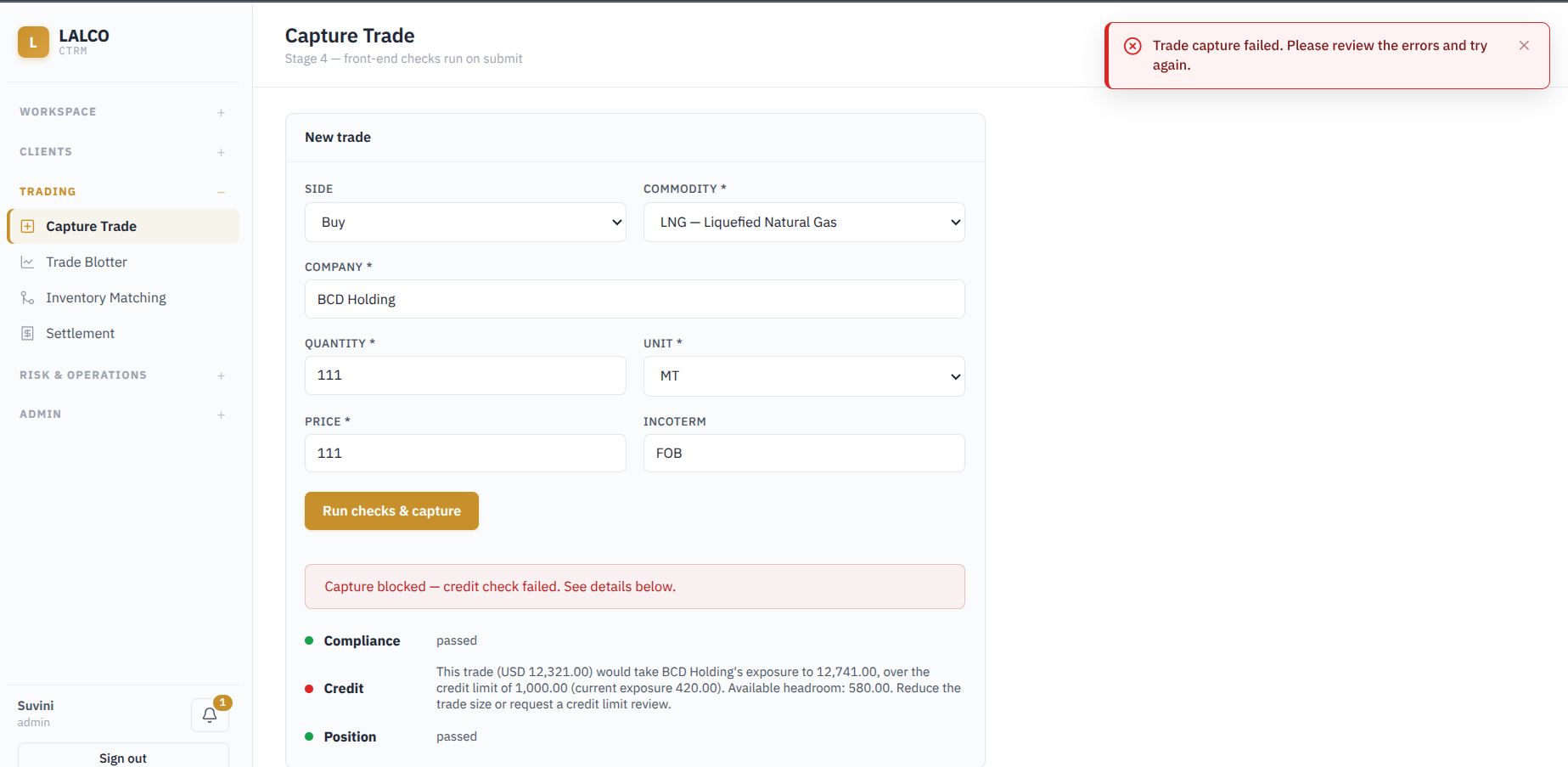
Credit Check Calculation
The Credit Check verifies whether the counterparty has enough available credit to support the new trade. The system compares the value of the new trade with the counterparty’s current exposure and credit limit.
1. Calculate the value of the new trade
Trade Value = Quantity × Price
Example: 111 MT × USD 111 = USD 12,321
This is the value that the new trade would add to the counterparty’s exposure.
2. Check the counterparty’s current exposure
Current Exposure is the value already being used by the counterparty from previous/open transactions.
Current Exposure = USD 420
3. Calculate the new exposure
New Exposure = Current Exposure + Trade Value
USD 420 + USD 12,321 = USD 12,741
This shows what the counterparty’s total exposure would become if the new trade were accepted.
4. Calculate the available credit
Available Headroom = Credit Limit − Current Exposure
USD 1,000 − USD 420 = USD 580
The Available Headroom is the amount of credit the counterparty still has available for new trades.
5. Credit decision
The new trade requires USD 12,321, but only USD 580 of credit is available. Therefore, the new exposure would exceed the company’s credit limit.
Result: Credit Check Failed → Trade Capture Blocked
3.2 Trade Bottler
The Trade Blotter provides a centralized list of all captured trades in the system. It allows users to review the main trade details, filter the list, and perform actions based on the current trade status.
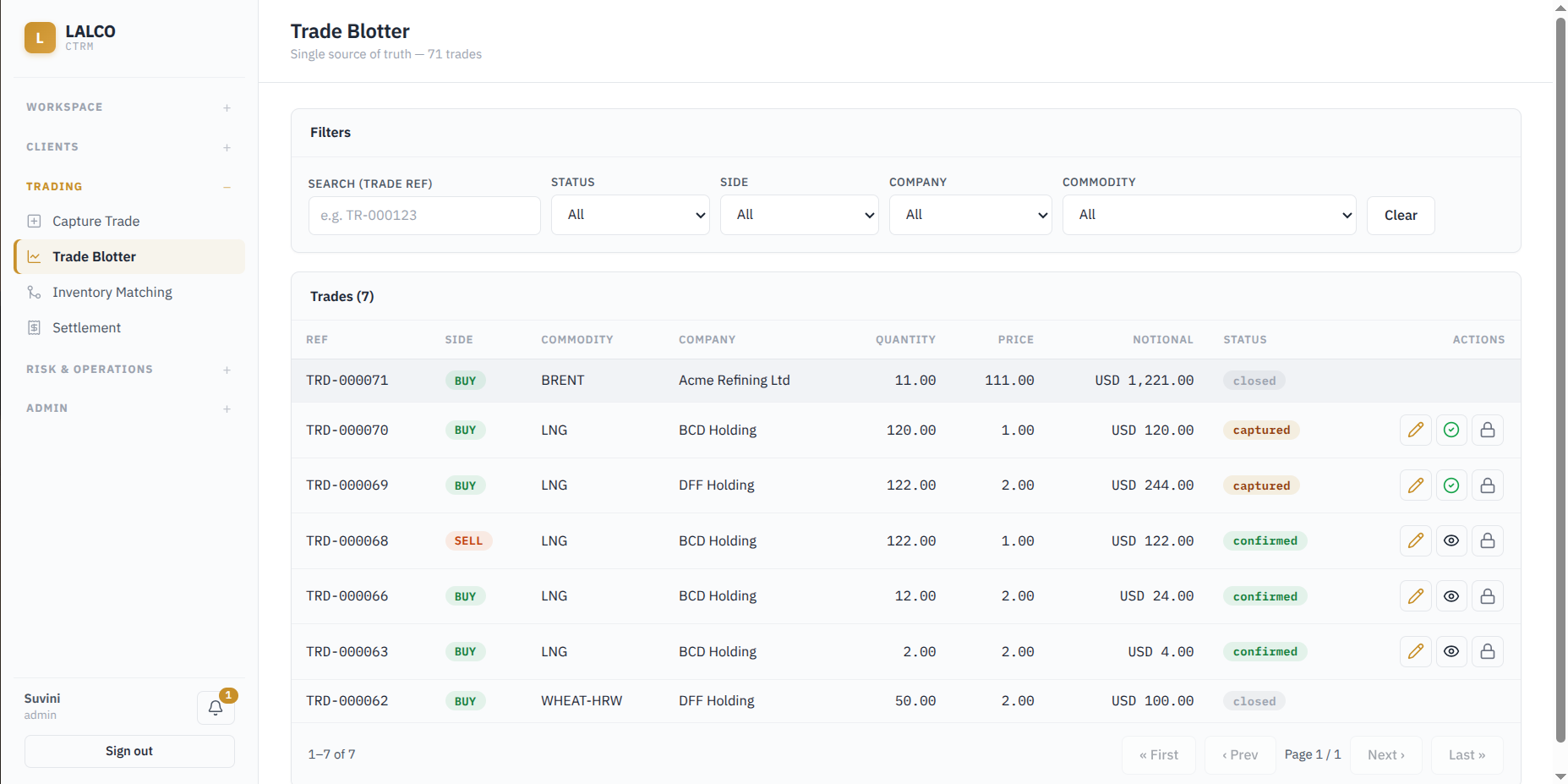
Filters
- Search (Trade Ref) – Finds a trade using its reference number.
- Status – Filters trades according to their current status. (captured, Confirmed, Closed)
- Side – Filters trades by Buy or Sell.
- Company – Filters trades by the selected counterparty/company.
- Commodity – Filters trades by commodity.
View Trade information
- Ref – Unique trade reference number.
- Side – Indicates whether the trade is a Buy or Sell.
- Commodity – Commodity involved in the trade.
- Company – Counterparty associated with the trade.
- Quantity – Quantity traded.
- Price – Agreed price per unit.
- Notional – Total trade value. (Total Trade value = Quantity * Price)
- Status – Current stage of the trade.
- Actions – Available actions for managing the trade.
Trade statuses shown
- Captured – Trade has been created and recorded in the system.
- Confirmed – Trade has been confirmed and moved to the next stage.
- Closed – Trade has completed its lifecycle and is no longer active.
Amend Trade
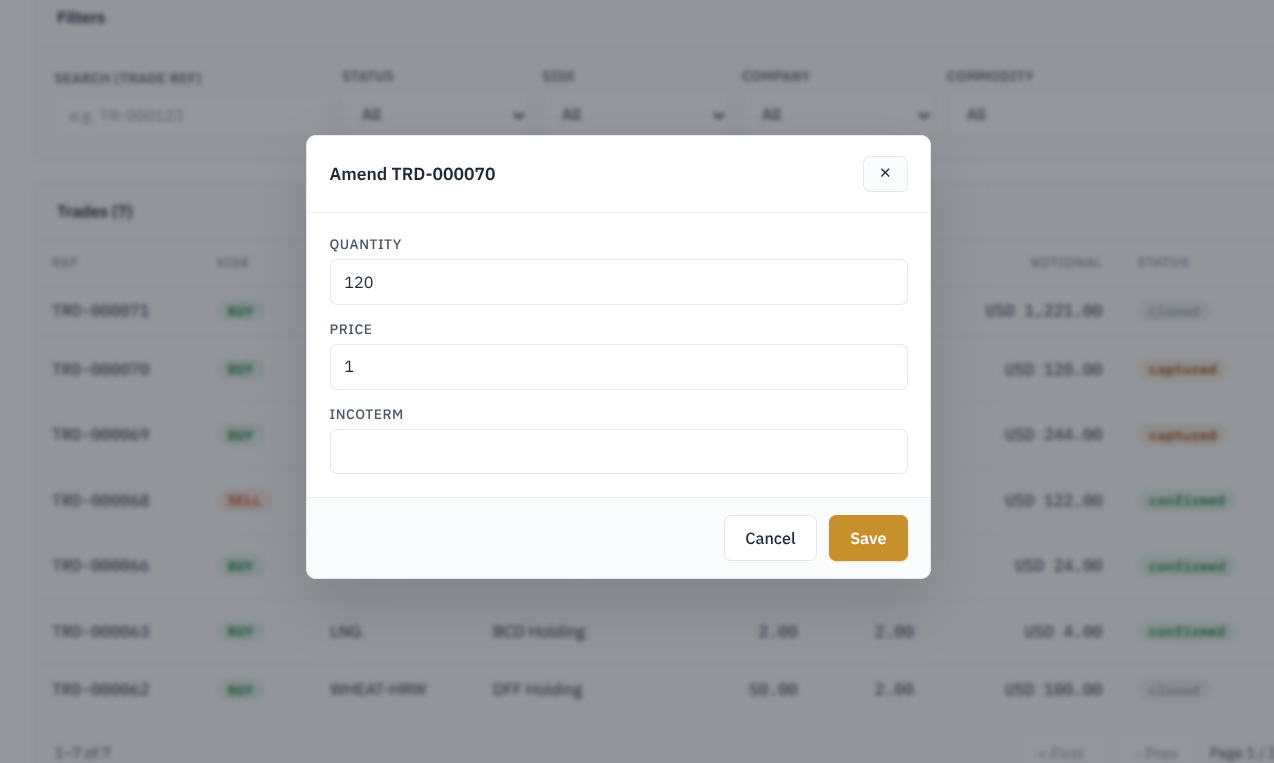
Editable amends
- Quantity – Updates the quantity of the trade.
- Price – Updates the agreed price.
- Incoterm – Updates the delivery term, such as FOB or CIF.
**The amendment option does not allow the user to change core trade details such as the trade reference, Buy/Sell side, commodity, or company from this form.**
Confirm Trade
The Confirm Trade action is used to move a captured trade into the active trading book.
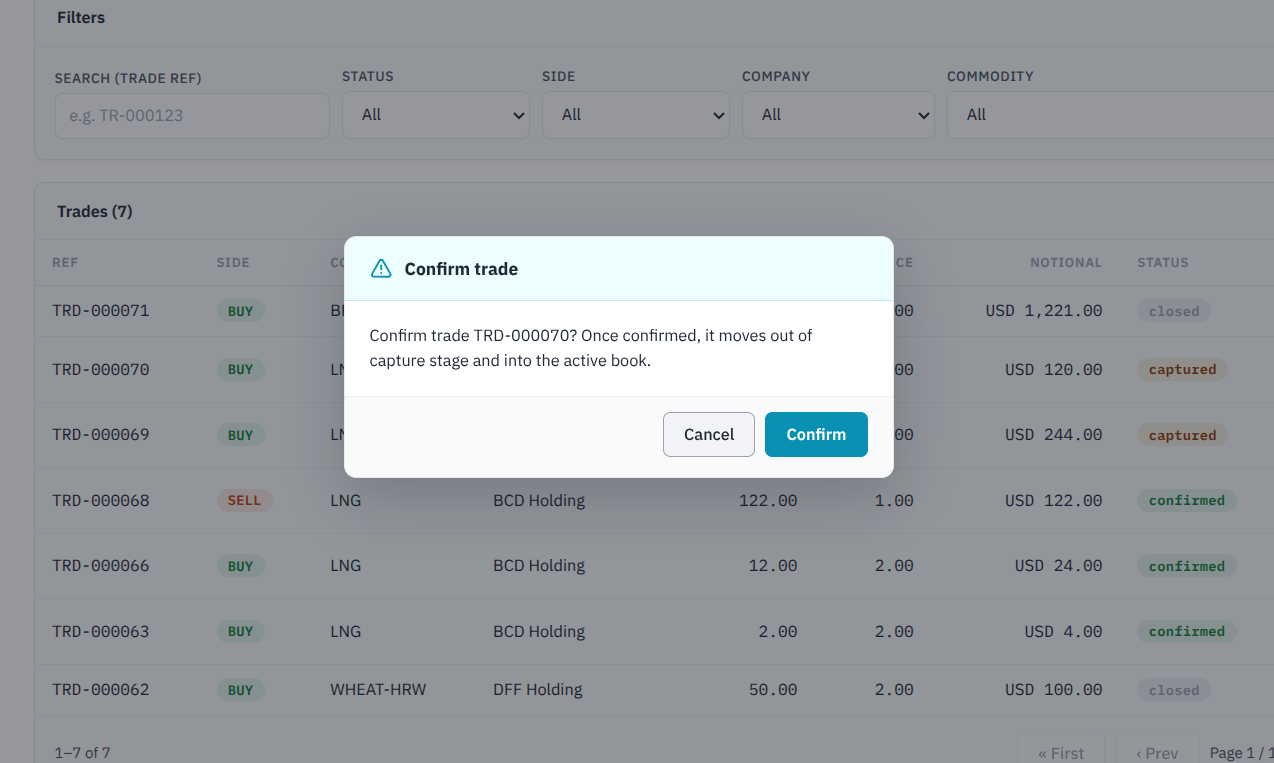
- Confirm – Changes the trade status from Captured to Confirmed.
- Cancel – Closes the message without making any changes.
Once confirmed, the trade moves out of the capture stage and becomes part of the active book, meaning it is now treated as an active confirmed trade within the CTRM system.
Flow = Captured → Confirmed → Active Book
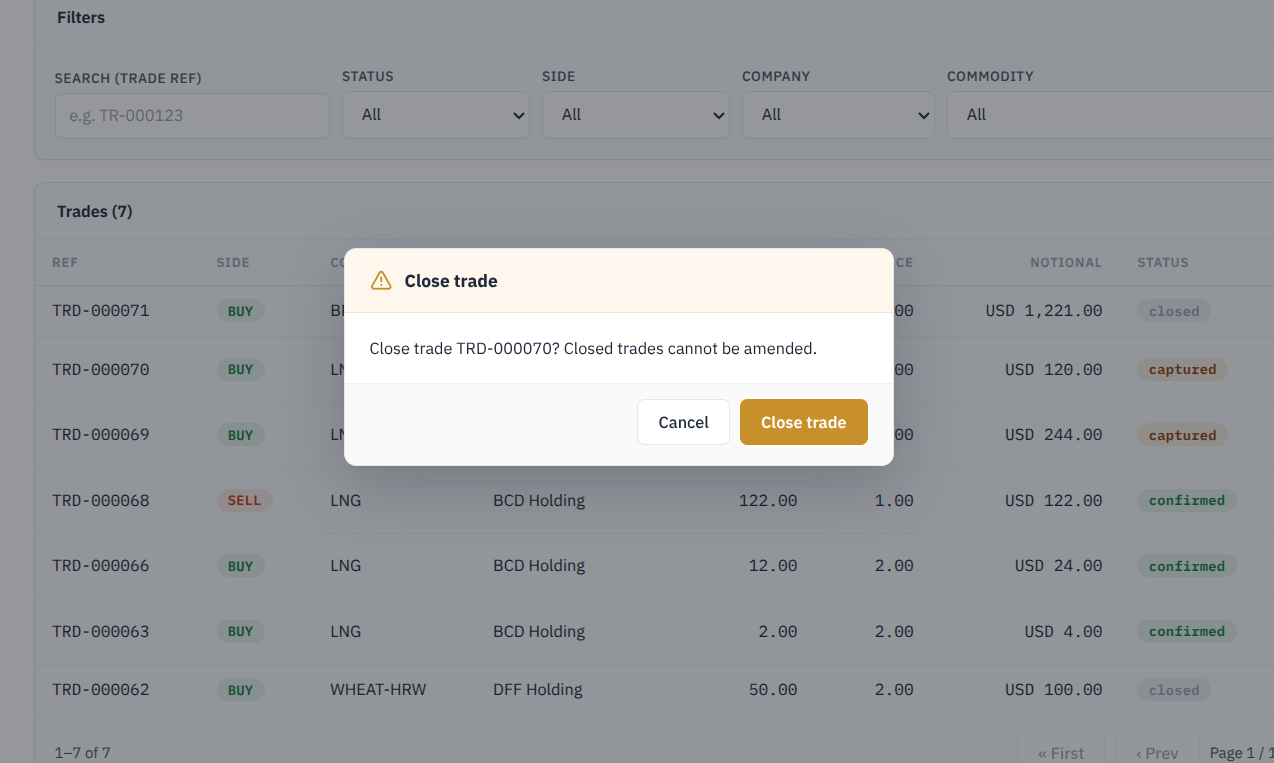
Close Trade
The Close Trade action is used to move a trade to its final Closed status.
Once a trade is closed, it cannot be amended.
3.3 Inventory Matching
The Inventory Matching module is used to allocate available inventory from Buy trades against Sell trades. It helps users identify how much inventory has already been assigned and how much is still available for allocation.
Filters
- Search by Trade Ref or commodity
- Status - Filters inventory lots according to their current status (Open, Fully Allocated)
- Commodity – Filters inventory lots by commodity.
View Inventory Lot of Information
- Buy Ref – Reference number of the Buy trade that created the inventory.
- Commodity – Commodity available in the inventory lot.
- Company – Company/counterparty associated with the Buy trade.
- Total – Original quantity available from the Buy trade.
- Allocated – Quantity that has already been matched to Sell trades.
- Available – Quantity that is still available to be matched.
- Unit Cost – Cost per unit of the inventory.
- Status – Current status of the inventory lot.
- Actions – Allows the available inventory to be allocated to a Sell trade.
Allocate Inventory to Sell Trade
The Allocate option is used to match available inventory from a Buy trade to a selected Sell trade.
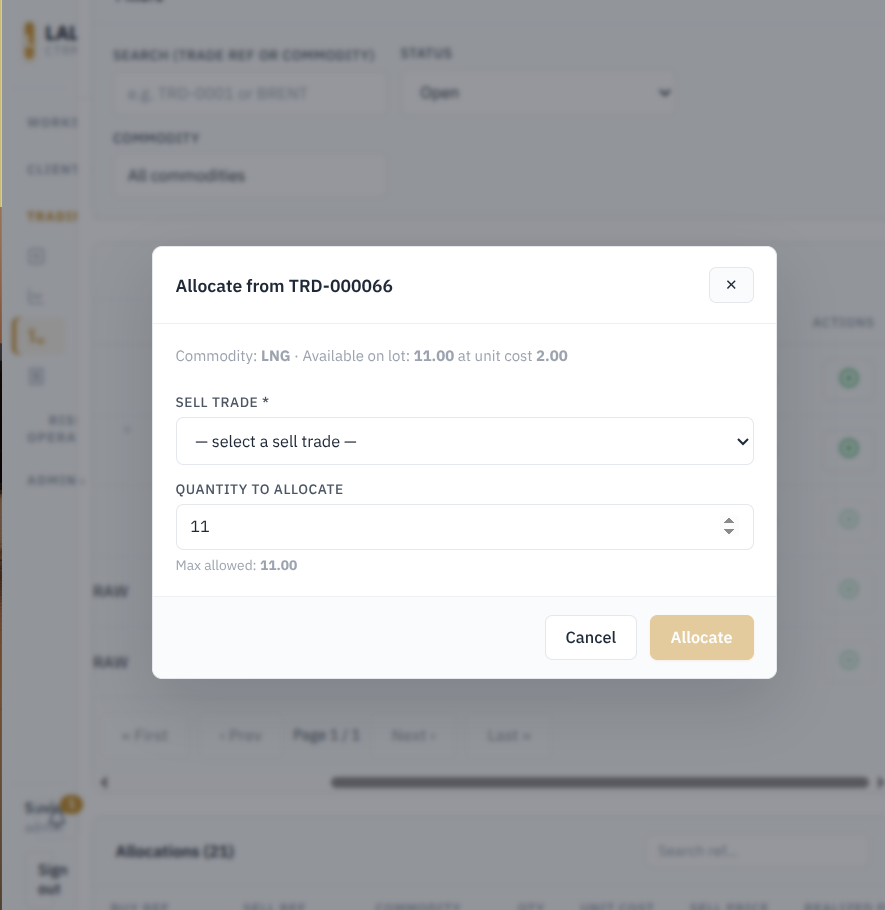
- Sell Trade: Select the sell trade that inventory should be allocated to
- Quantity to Allocate: Enter the quantity to be assigned to the seleted sell trade
- Max Allowed: Shows the maximum quantity that can be allocated based on the inventory currently available
The available quantity cannot be greater than available quantity
Allocations
The Allocations section shows the inventory quantities that have already been matched between Buy and Sell trades.
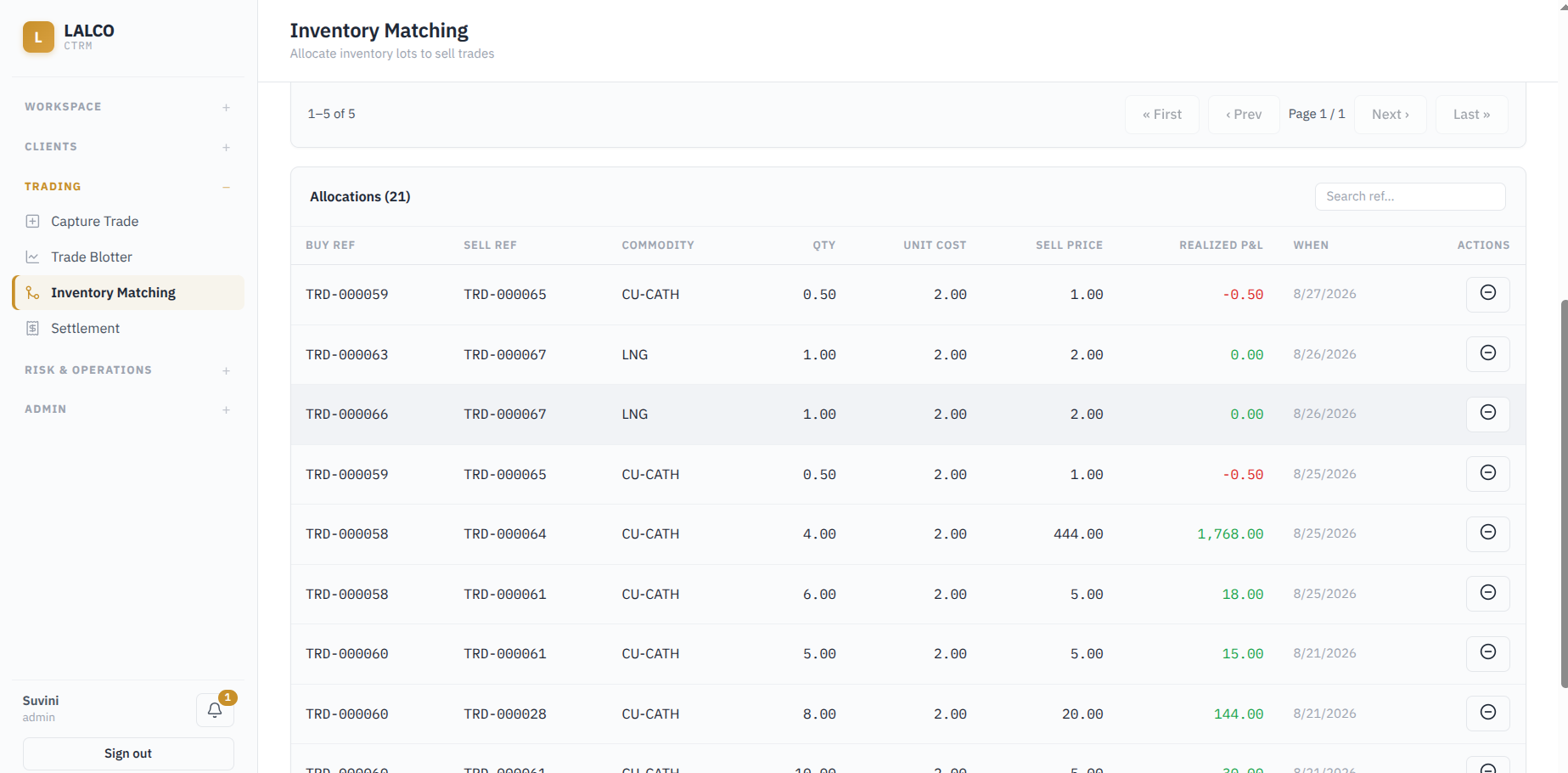
- Buy Ref – Reference of the Buy trade supplying the inventory.
- Sell Ref – Reference of the Sell trade receiving the inventory.
- Commodity – Commodity being matched.
- Qty – Quantity allocated from the Buy trade to the Sell trade.
- Unit Cost – Purchase cost per unit from the Buy trade.
- Sell Price – Selling price per unit from the Sell trade.
- Realized P&L – Actual profit or loss generated from the allocated quantity.
- When – Date the allocation was made.
- Actions – Provides an action for the allocation
Realized P&L Calculation
System calculates the profit or loss generated when inventory purchased at one price is allocated to a Sell trade at another price.
Realized P&L = (Sell Price − Unit Cost) × Allocated Quantity
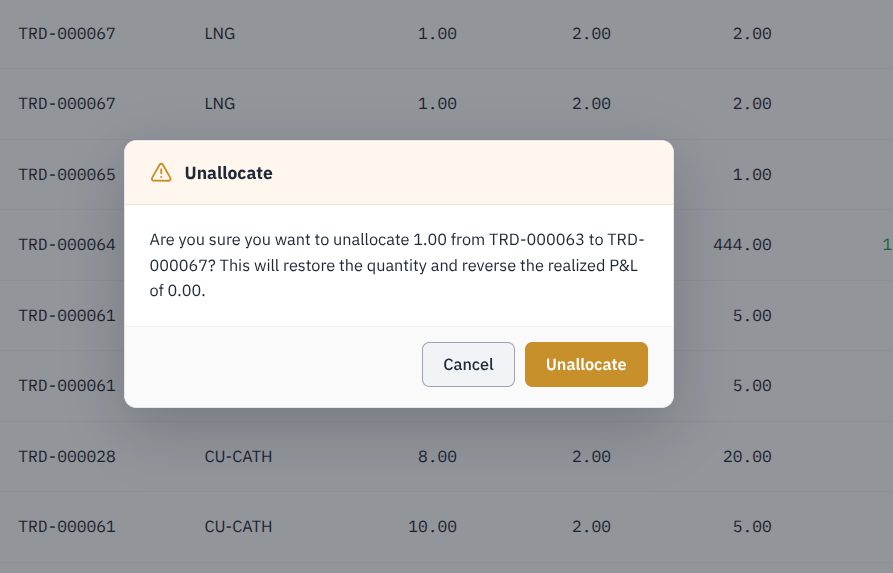
Unallocate Inventory
The Unallocate option is used to remove an existing match between a Buy trade and a Sell trade.
- The allocated quantity is returned to the original Buy inventory lot.
- The available inventory quantity is increased again.
- Any Realized P&L created by that allocation is reversed.
- Unallocate confirms and removes the allocation.
3.4 Settlement
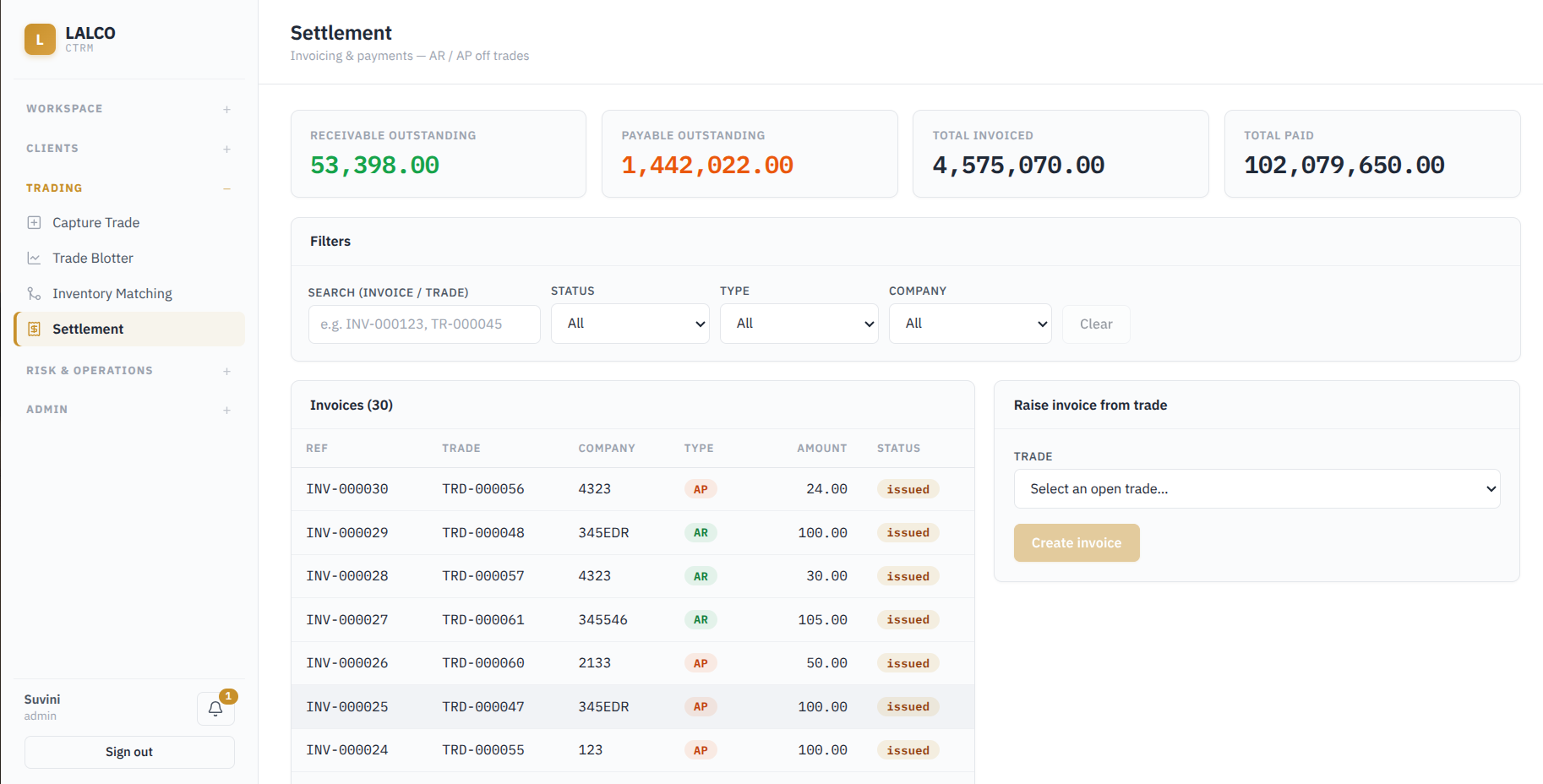
Used to manage invoices and payments related to trades. It provides a view of amounts that need to be received from counterparties and amounts that need to be paid.
View settlement
- Recievable outstanding
- Payable Oustanding
- Total Invoiced
- Total Paid
Filters
- Search : Find records using an invoice reference or trade reference
- Status : Filters invoices according to their current status
- Type : Filter invoices by AP, AR (Accounts Recievable , Accounts Payable)
- Company : Filters invoices by the related company
Invoice Information
- Ref
- Trade
- Company
- Type
- Amount
- Status
Raise Invoices from Trade
The Raise Invoice from Trade section allows a user to create an invoice from an existing open trade.
When creating an invoice from a trade, the system checks whether that trade already has an active invoice.
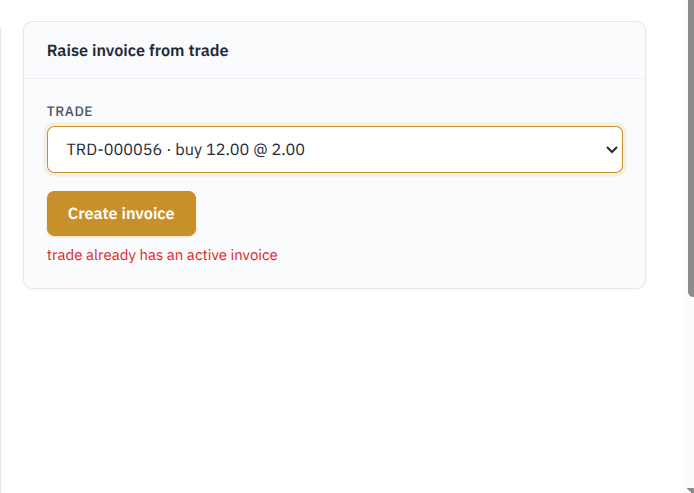
Flow = Open Trade → Create Invoice → AR or AP Invoice → Payment / Receipt → Settlement
Invoice & Payment Details
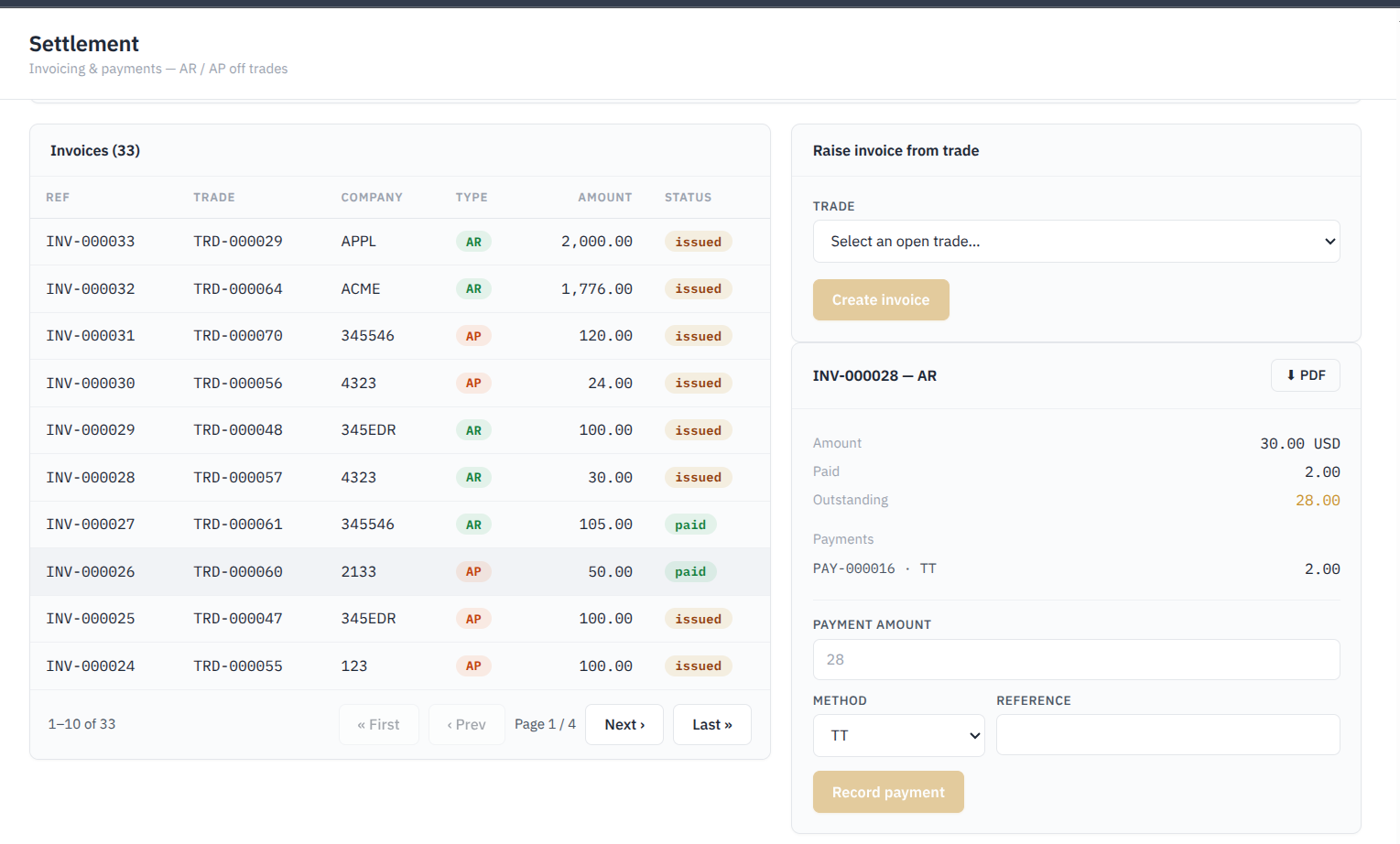
When an invoice is selected, the system displays its current settlement information:
- Amount – Total value of the invoice.
- Paid – Amount already paid or received against the invoice.
- Outstanding – Remaining amount that still needs to be settled.
- Payments – Shows any payments previously recorded against the invoice.
- PDF – Allows the invoice to be downloaded as a PDF.
Record Payment
The Record Payment section is used to record a payment made or received against the selected invoice.
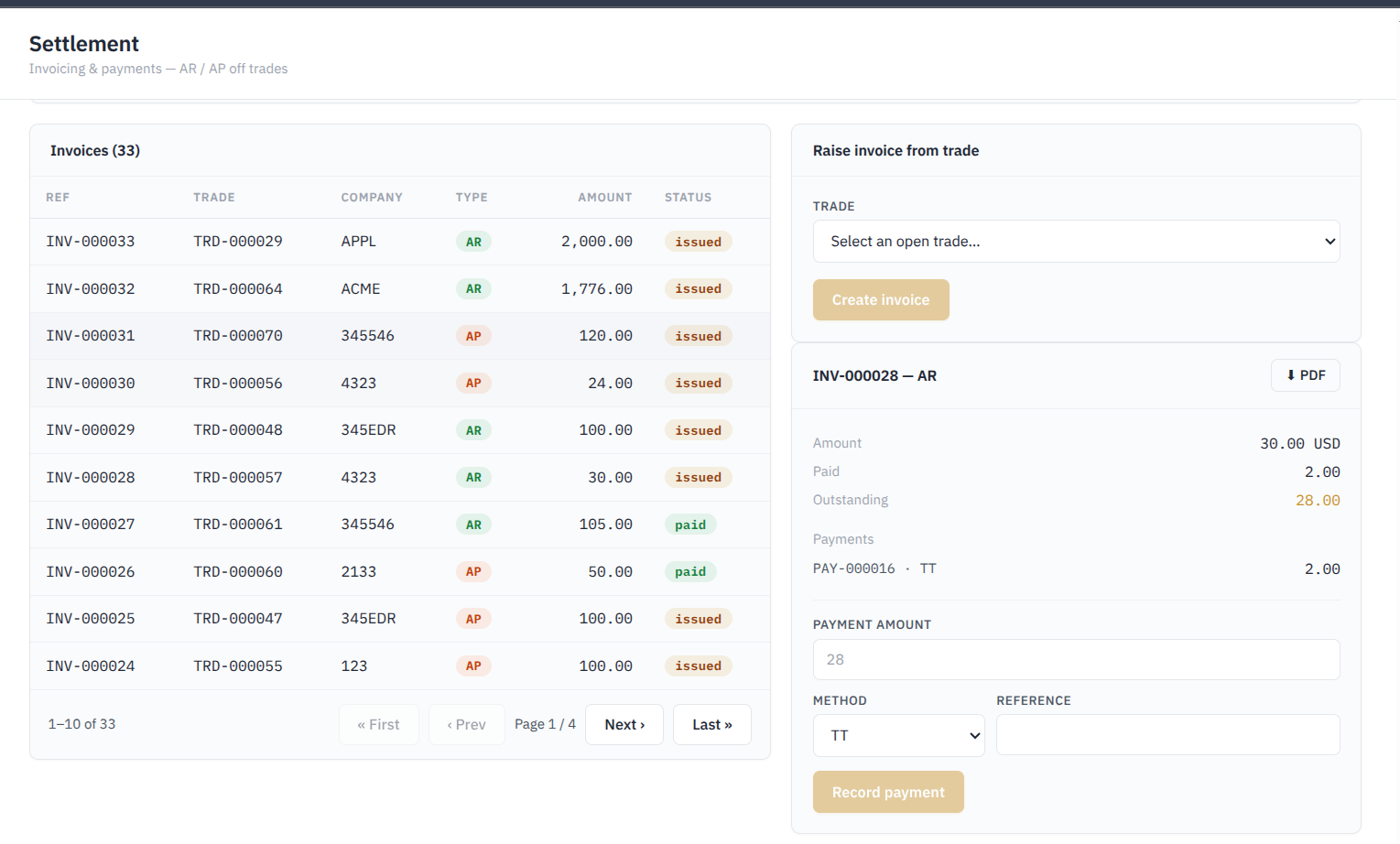
- Payment Amount – Amount being paid or received.
- Method – Payment method used, such as TT (Telegraphic Transfer / bank transfer).
- Reference – Reference number or other identifier related to the payment.
- Record Payment – Saves the payment against the invoice.
For an AR invoice, the payment represents money received from the counterparty. For an AP invoice, it represents money paid to the counterparty.
4. Risk And Operations
The Risk & Operations section is used to monitor the financial value and risk of open trades and to support operational activities such as hedging, market data, physical movements, logistics, contracts, and documents.
4.1 Valuation & P&L
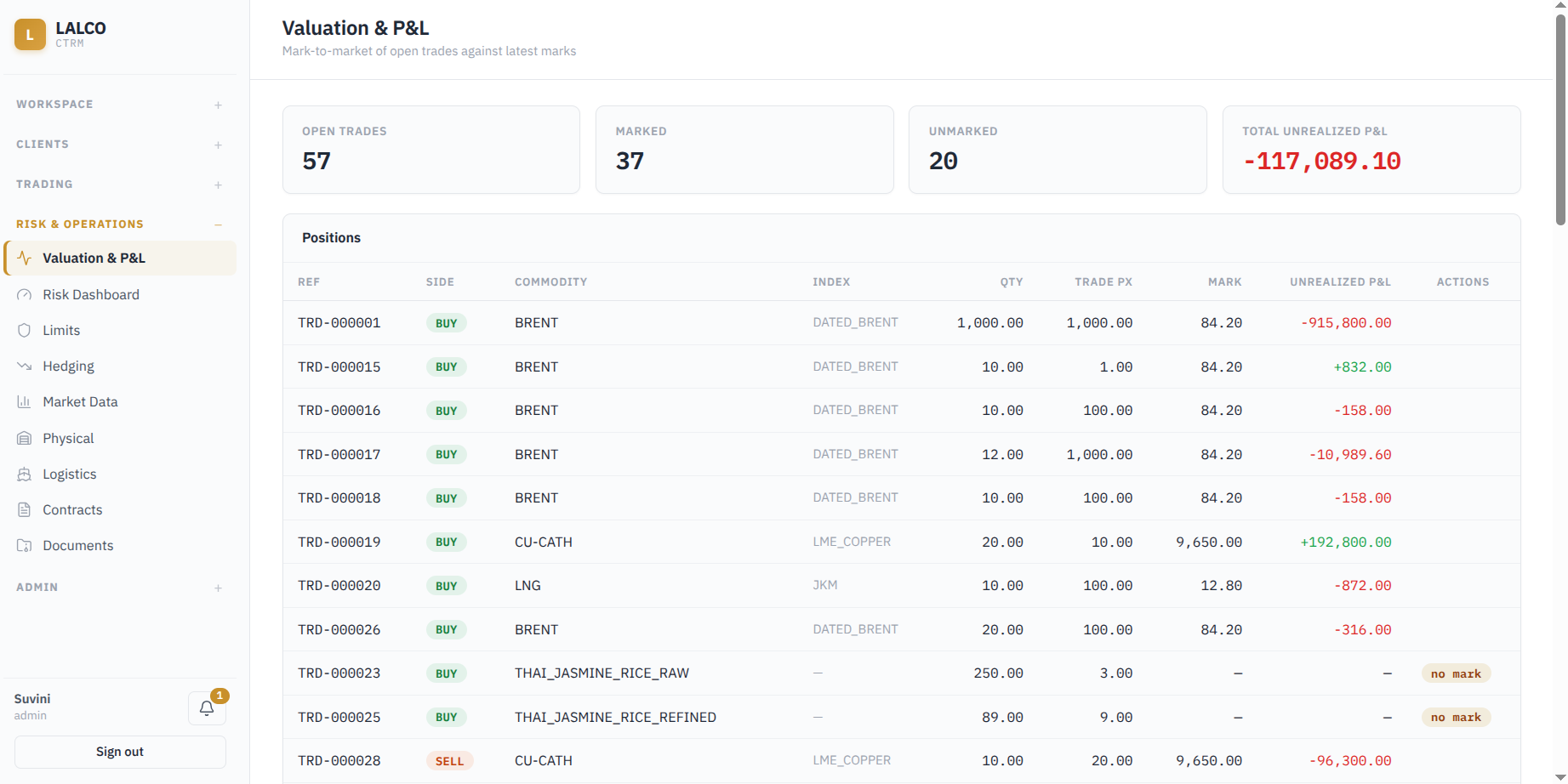
Shows the current value of open trades by comparing the original trade price with the latest available market price. This helps users identify the unrealized profit or loss on each open position.
Summary Cards
-
Open Trades – Total number of trades that are currently open.
-
Marked – Open trades that have an available market price and can therefore be valued.
-
Unmarked – Open trades for which a market price is not currently available.
-
Total Unrealized P&L – Combined unrealized profit or loss of the marked open positions.
Position Information
-
Ref – Unique trade reference number.
-
Side – Indicates whether the position is a Buy or Sell.
-
Commodity – Commodity involved in the trade.
-
Index – Market price/index used to value the commodity.
-
Qty – Quantity of the open position.
-
Trade Px – Price at which the trade was originally entered.
-
Mark – Latest market price used to value the position.
-
Unrealized P&L – Current estimated profit or loss of the open position
Unrealized P&L Calculation
- For buy position
Unrealized P&L = (Mark Price − Trade Price) × Quantity - For sell position
Unrealized P&L = (Trade Price − Mark Price) × Quantity - Total Unrealized P&L
Total Unrealized P&L = Sum of the Unrealized P&L of all marked open positions
Marked and Unmarked Trades
A trade can only have Unrealized P&L calculated when a valid Mark Price is available.
If no market price/index is available, the trade is shown as No Mark, and its Unrealized P&L cannot currently be calculated.
4.2 Risk Dashboard
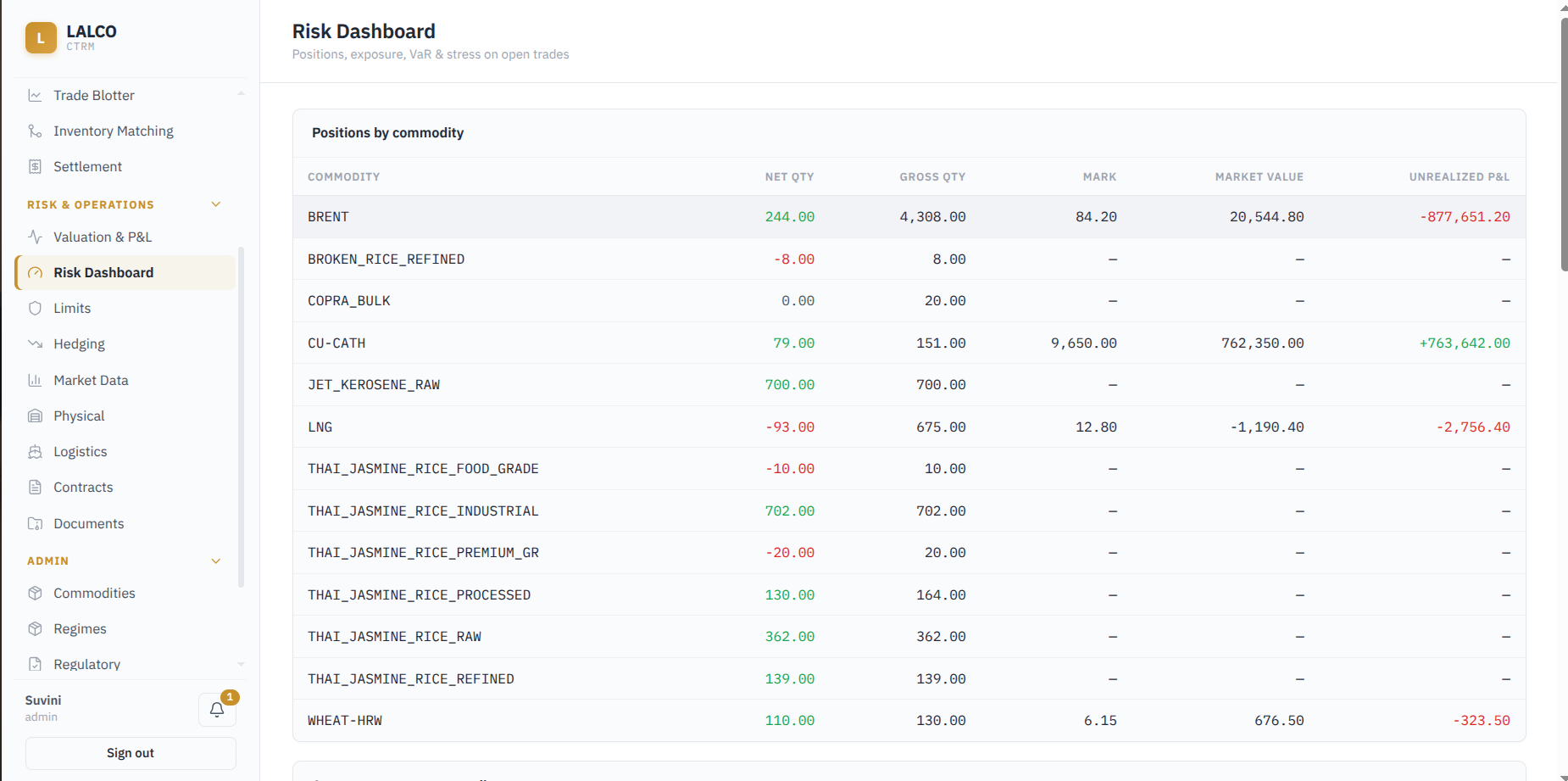
The Risk Dashboard provides an overall view of the company’s current trading positions and risk exposure across open trades.
Positions by Commodity
The system groups open trades by commodity and shows the overall position for each one.
- Commodity – Commodity being monitored.
- Net Qty – Remaining position after Buy and Sell quantities are offset against each other.
- Gross Qty – Total quantity traded without offsetting Buy and Sell positions.
- Mark – Latest market price used to value the commodity.
- Market Value – Current value of the net position based on the latest market price.
- Unrealized P&L – Estimated profit or loss on the open positions based on current market prices.
Calculations
1. Net Quantity
Net Qty = Total Buy Quantity − Total Sell Quantity
- A positive Net Qty indicates a net long/buy position.
- A negative Net Qty indicates a net short/sell position.
- A value of 0 means the Buy and Sell quantities are fully offset.
2.Gross Quantity (shows the overall trading activity without offsetting Buy and Sell positions.)
Gross Qty = Total Buy Quantity + Total Sell Quantity
3. Market Value
Market Value = Net Quantity × Mark Price
Company exposure vs credit
This section shows the current open exposure of each company compared with its assigned credit limit. It helps users identify companies that are approaching or exceeding their credit limits.
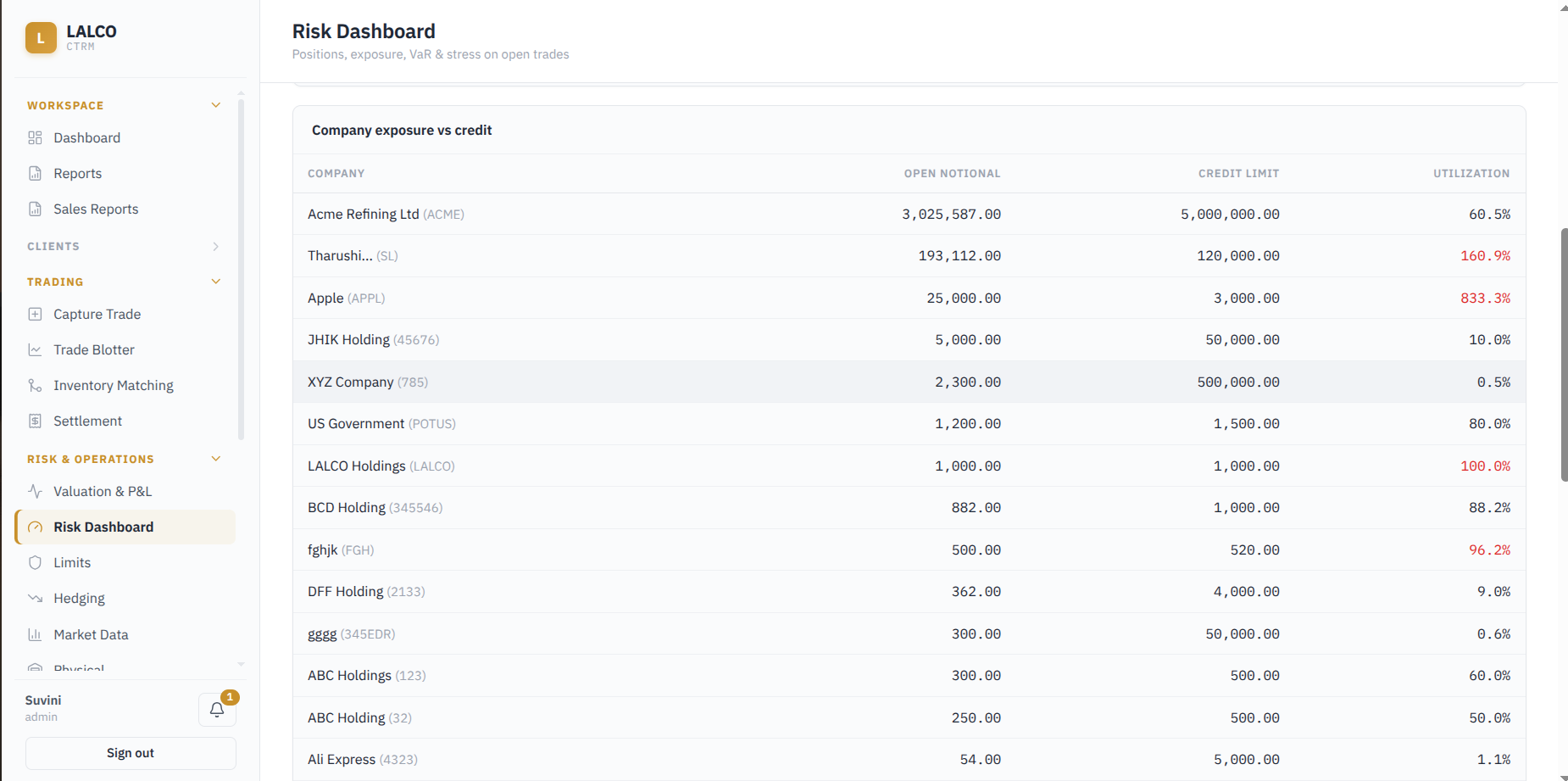
- Company - Name and code of the company.
- Open Notional - Total notional value of the company's currently open trades.
- Credit limit - Maximum credit/exposure limit assigned to the company.
- Utilization - Percentage of the credit limit currently being used.
Calculations
1.Utilization
Utilization (%) = (Open Notional ÷ Credit Limit) × 100
Risk Indication by Utilization: The utilization percentage helps identify the company's credit position:
- Below 100% – Open exposure is within the credit limit.
- 100% – The credit limit is fully utilized.
- Above 100% – Open exposure exceeds the credit limit.
Value at Risk
Estimates the potential loss of the current open trading positions over a one-day period based on the selected confidence level and market volatility.

Confidence - The probability level used to estimate the potential loss. (99% or 95%)
Annual Volatility – The annualized volatility used to estimate potential price movements
Stress test
4.3 Limits
Used to define position and exposure limits. These limits are enforced when trades are captured to help control the level of risk and exposure.
Existing Limits
- Name - Name of the limit
- Scope - What limit applies to. (Commodity, counterparty, Book, Global)
- Target - The specific commodity or counterparty to which the limit applies
- Metric - The measurement used for the limit, such as Net Quantity or Gross Quantity.
- Max - Maximum value allowed for the selected metric.
- Status - Shows whether the limit is currently Active.
- Actions - Allows the user to edit the max credit limit and disable the limit. (Active or inactive)
Active Breaches
Shows limits where the current value has exceeded the configured maximum limit.
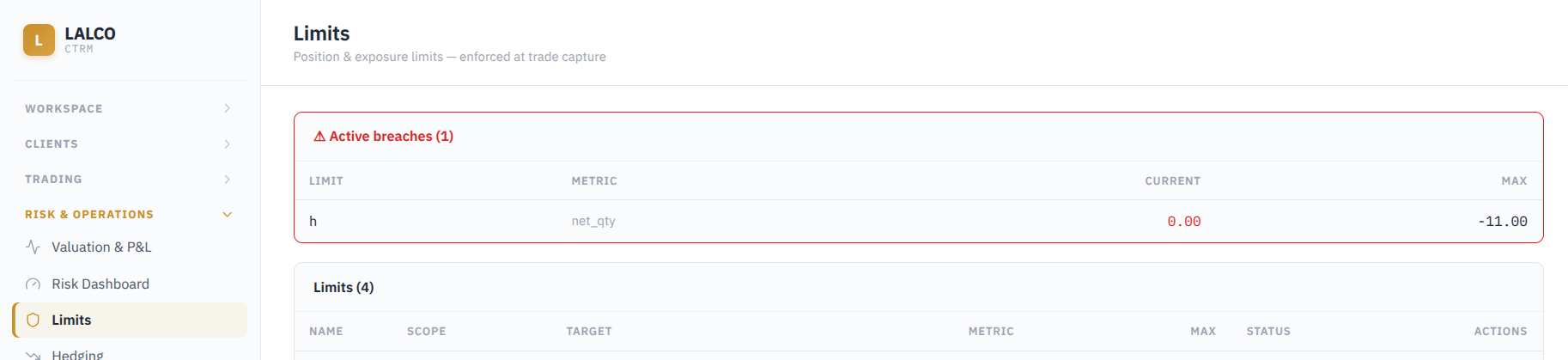
- Limit - Name of the limit that has been breached.
- Metric - The measurement used for the limit, such as Net Quantity or Gross Quantity.
- Current - Current value of the selected metri
- Max - Maximum value configured for the limit
Create Limit
- Name
- Scope
- Book Name
- Metric
- Max value
4.2 Hedging
Allows users to monitor, manage, and evaluate hedge strategies and their effectiveness across various commodities and financial instruments. Allows traders, risk managers, and operations staff to align financial derivative instruments (futures, options, swaps) against physical commodity exposures (e.g., Rice, Wheat).
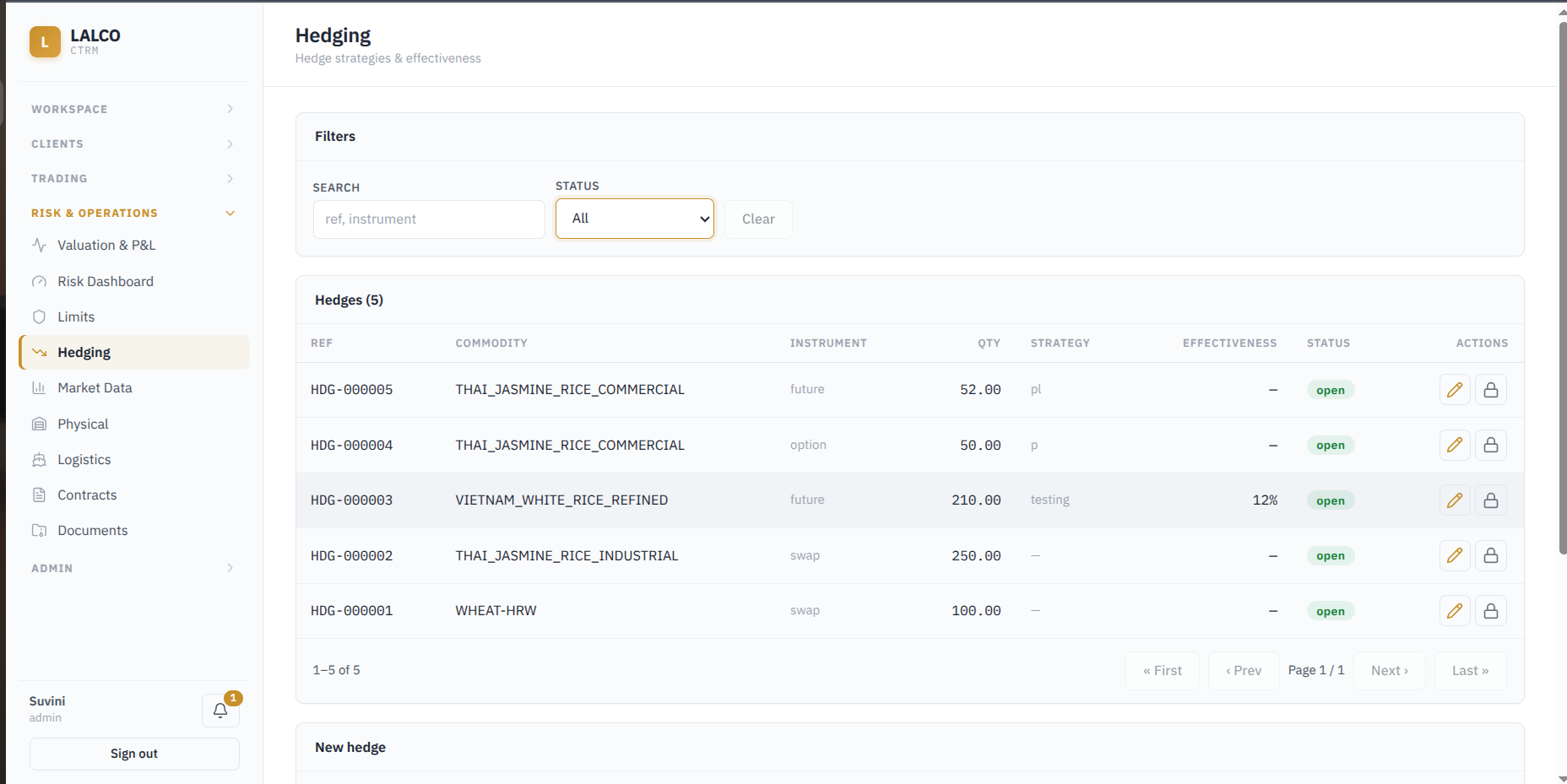
Filters
- Search by reference and instrument
- Status :
- Open (The hedge is currently active. The derivative contract has been executed but not yet settled or offset, meaning it is still actively managing the price risk for the underlying physical commodity.)
- Close (The hedge has been completed. The derivative contract has expired, been sold, or settled,it is no longer actively covering any current risk.)
View Hedges
- Ref - Unique reference of the hedge
- Commodity - The target physical commodity exposure being hedged
- Instrument - Financial derivative type used (Future, Option, Swap)
- Qty - volume or quantity (negative value means a sell/short position)
- Strategy - custom tagging
- Effectiveness - Percentage showing how well the hedge protects against price changes
- Status - Shows if the hedge is currently active (Open) or completed (Closed)
- Actions - Edit or close a hedge
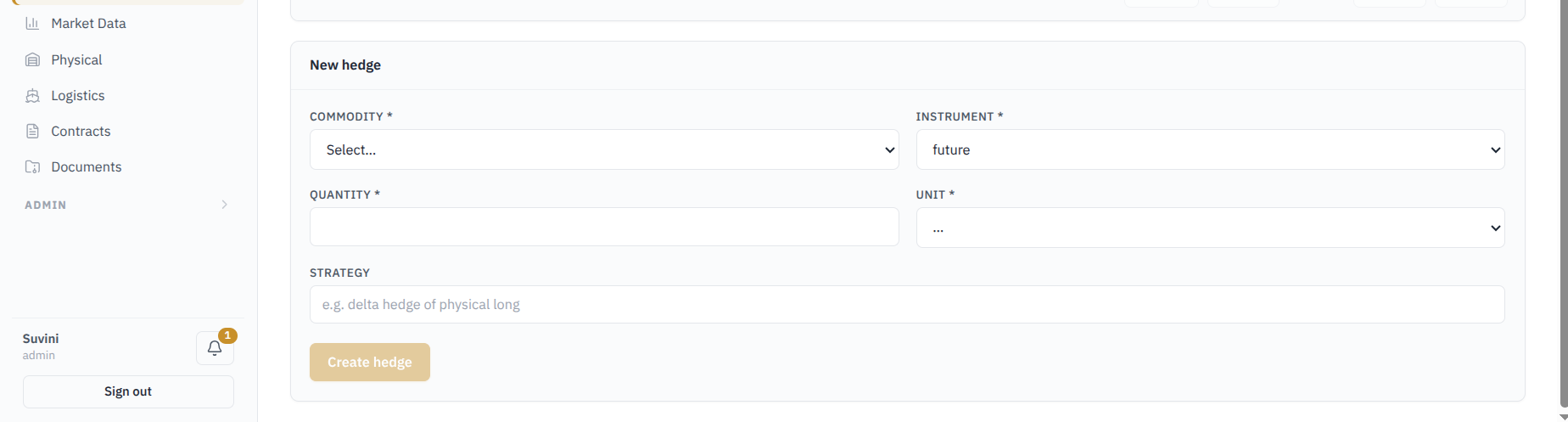
Create a new hedge
-
Commodity - The physical commodity you are hedging Required
-
Instrument -The type of derivative contract (e.g., Future, Option, Swap) Required
-
Quantity - Enter the numerical amount of the commodity to hedge. Required
-
Unit - Select the measurement unit for the quantity (e.g., tons, bushels, lots) Required
-
Strategy - Add an optional tag or description for your hedging approach
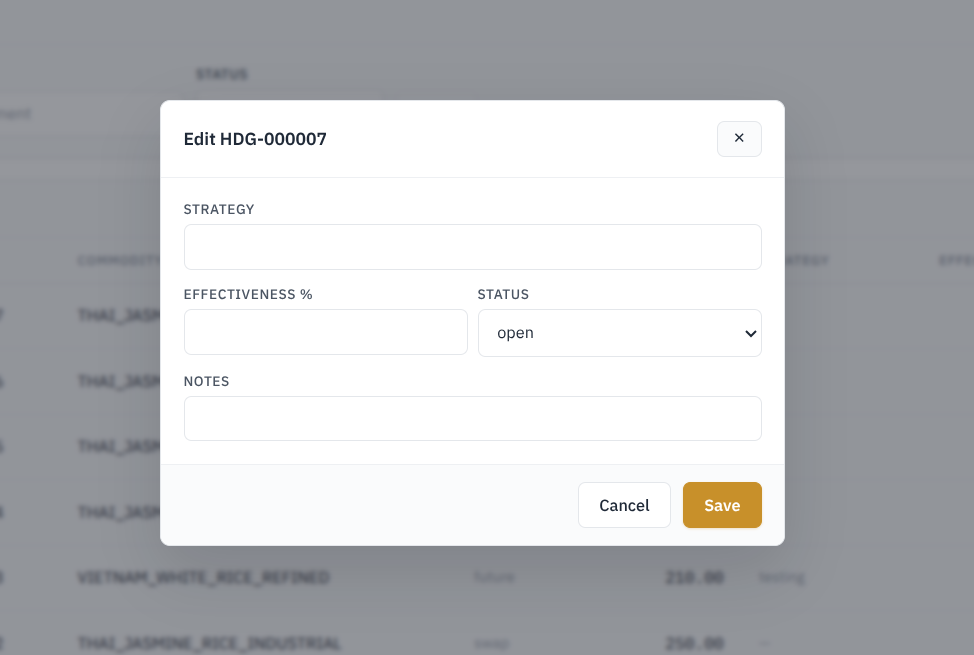
Edit a hedge
-
Strategy - Update the custom tag or description for your hedging approach
-
Effectiveness % - Enter or update the numerical score showing how well the hedge is performing
-
Status - Change the current state of the hedge (e.g., from Open to Closed)
-
Notes - Add any relevant comments, details, or context about this specific record
LALCO CTRM End-to-End Process Flow